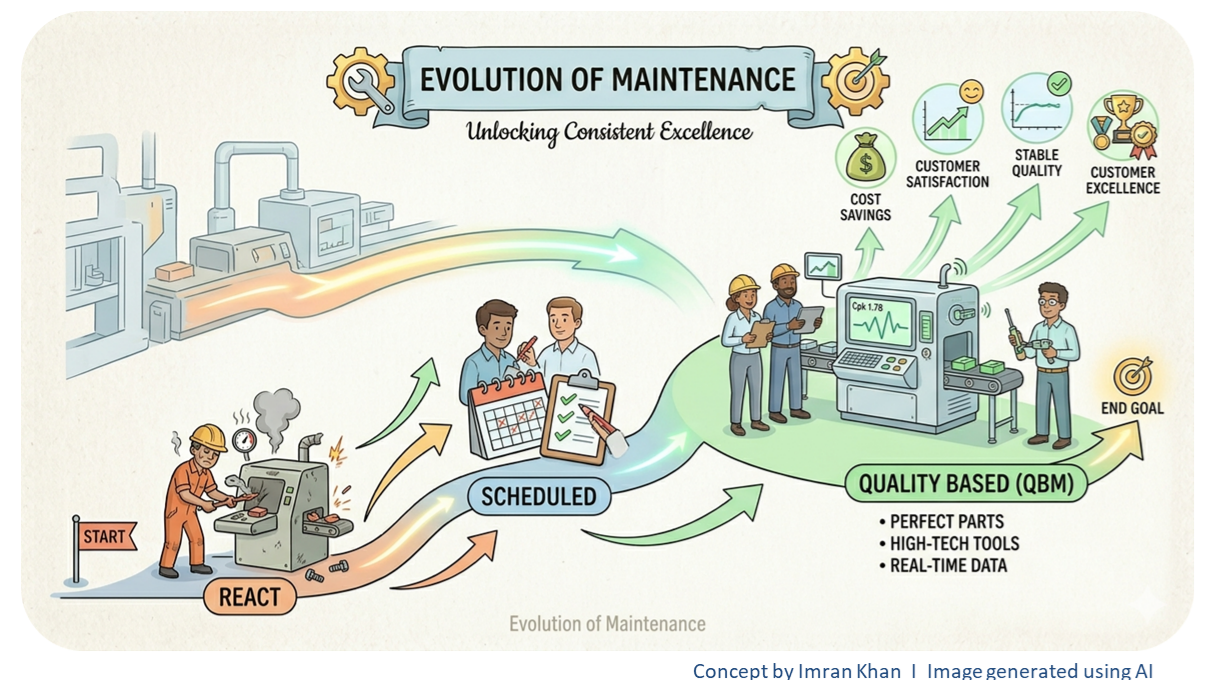
Traditional maintenance focuses on one question: “Is the machine running?”
But from a quality perspective, that is not enough.
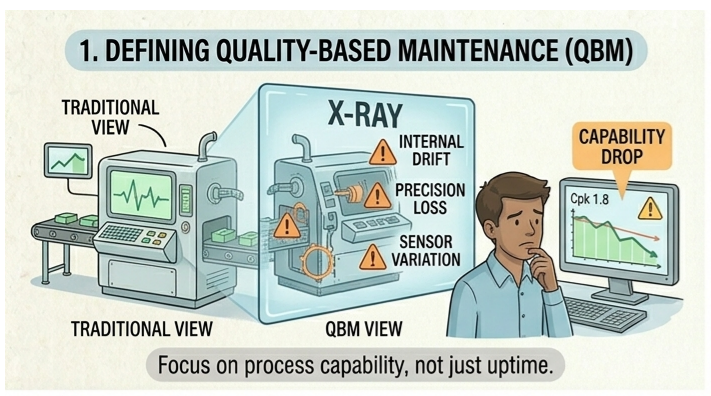
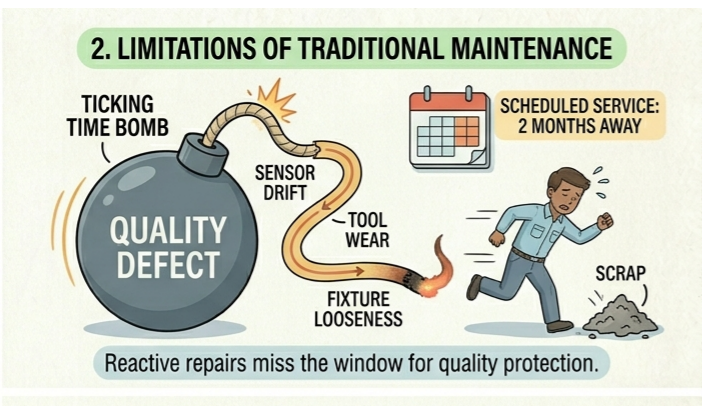
Many machines continue to run while gradually creating defects, variation, rework and customer complaints. Tool wear, fixture looseness, pressure variation, sensor drift, spindle runout or poor calibration may not stop the machine, but they can reduce process capability significantly.
A machine does not need to fail to create poor quality.
This is where Quality Based Maintenance (QBM) becomes important. QBM focuses on maintaining machines based on their impact on product quality, process capability and special characteristics rather than only breakdown history or maintenance schedule.
Because a machine can still be available and still be incapable.
What is Quality Based Maintenance?
Quality Based Maintenance (QBM) is an approach where maintenance activities are planned based on the machine’s impact on product quality, process capability and special characteristics.
Traditional maintenance mainly focuses on preventing machine breakdowns and improving uptime. QBM goes one step further by asking whether the machine is still capable of producing conforming product consistently.
Under QBM, machines are monitored not only for downtime, vibration or breakdown history, but also for indicators such as rejection trend, Cp/Cpk deterioration, SPC violations, customer complaints, tool wear, calibration drift and repeat defects. The objective is simple:
Maintain the machine before its condition starts affecting product quality.
Why Traditional Maintenance is Not Enough
“A machine may be running, but that does not mean it is producing good quality consistently.”
Many quality problems start much before the machine actually breaks down. Fixture wear, tool wear, unstable pressure, sensor drift, spindle looseness, poor clamping force or calibration issues can gradually increase variation and reduce process capability.
In such cases, the machine is still available for production, but the process becomes unstable.
This is why relying only on breakdown maintenance or preventive maintenance schedules is not enough. Traditional maintenance protects uptime. QBM protects process capability and product quality.
Which Machines Should Be Covered Under QBM?
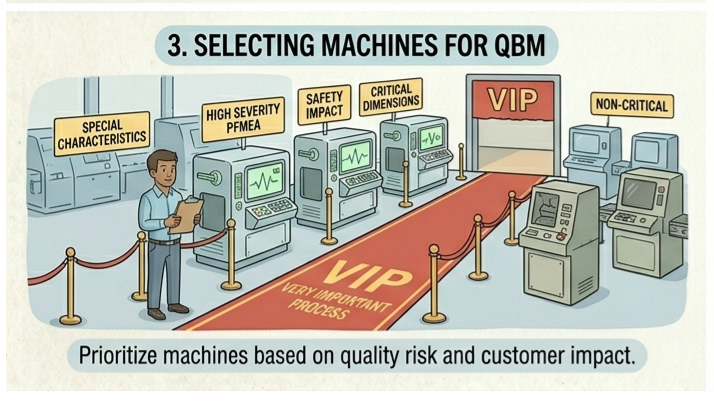
“A machine should enter QBM not because it breaks often, but because when it drifts, the customer feels it.”
QBM should focus on machines that directly affect product quality, process capability and customer risk.
Typical QBM machines include those linked to:
- Special Characteristics
- Critical or Significant Characteristics
- Safety or regulatory requirements
- High severity PFMEA items
- Frequent rejection or rework
- Customer complaints
- Poor Cp/Cpk trends
- Frequent operator adjustment
- Difficult-to-detect defects
- High sorting or containment activity
Examples may include torque tightening stations, welding machines, leak testing equipment, CNC machines controlling critical dimensions, heat treatment furnaces, vision systems and critical assembly fixtures.
Linking QBM with Special Characteristics
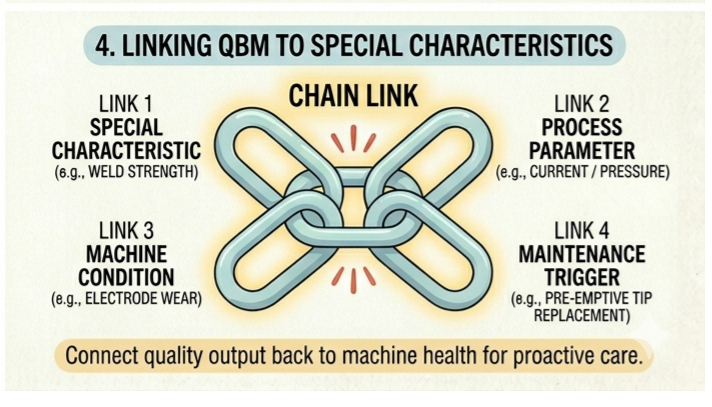
Every special characteristic is controlled by one or more process parameters, and those process parameters are influenced by machine condition.
“If a machine affects a special characteristic, it should be part of QBM.”
This makes it important to link Special Characteristic → Process Parameter → Machine Condition → Maintenance Trigger.
For example:
- Torque characteristic → tool calibration, spindle wear, air pressure
- Weld strength → current, electrode wear, welding pressure
- Leak tightness → fixture condition, sealing force, pressure stability
- Critical dimension → tool wear, vibration, fixture alignment
- Surface finish → tool sharpness, feed rate stability
By creating this link, maintenance becomes proactive and quality-focused instead of only time-based.
Signs That a Machine Needs Quality Based Maintenance
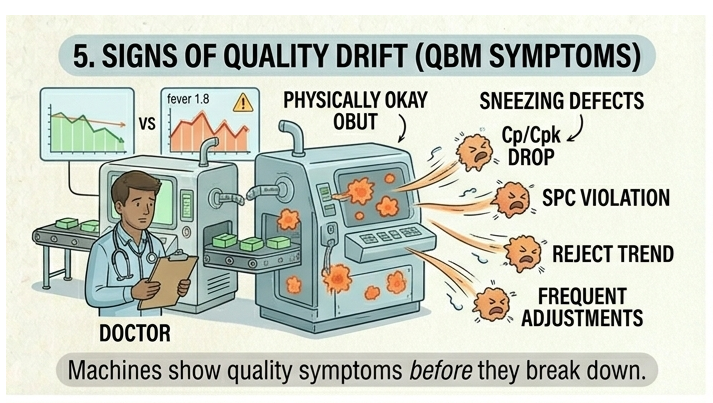
“Machines usually show quality symptoms before they show breakdown symptoms.”
A machine may require QBM attention if there is:
- Rising rejection trend
- Increasing rework or sorting
- Frequent operator adjustment
- Deteriorating Cp/Cpk values
- More SPC violations or trend shifts
- Repeat defects despite corrective action
- Customer complaints linked to the process
- Higher inspection dependency
- Increasing tool consumption
- Frequent calibration or MSA issues
These signals often indicate that the machine is gradually losing its ability to produce stable and conforming output.
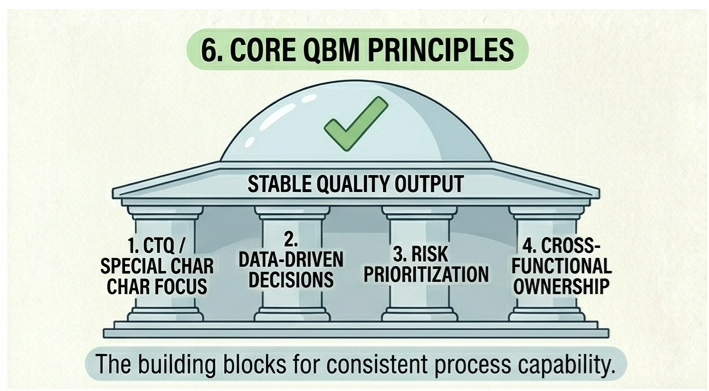
Core Principles of Quality Based Maintenance
Quality Based Maintenance should focus on the factors that directly influence product quality and process stability.
Key principles include:
- Maintain machines affecting CTQ and special characteristics
- Use rejection trend, SPC and process capability as maintenance inputs
- Link maintenance actions with defect trends
- Prioritize machines with high customer risk
- Integrate QBM with PFMEA, Control Plan and MSA
- Use operator feedback as an early warning signal
- Verify whether maintenance actually improved quality performance
Traditional maintenance protects uptime. QBM protects capability.
“The objective is not only to keep the machine running. The objective is to keep the process capable.”
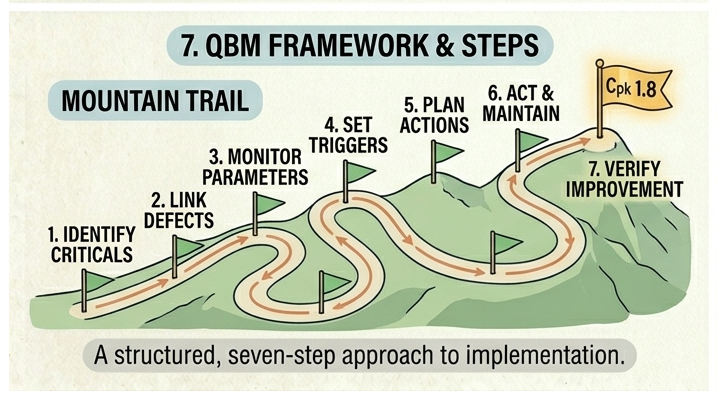
Quality Based Maintenance Framework
A simple QBM framework can be implemented in seven steps:
- Identify critical machines and special characteristics
- Link defects to machine conditions
- Define machine parameters to monitor
- Establish quality-based trigger limits
- Plan maintenance actions
- Verify quality improvement after maintenance
- Update PFMEA, Control Plan and lessons learned
“Maintenance should not start after a breakdown. It should start when quality begins to drift.”
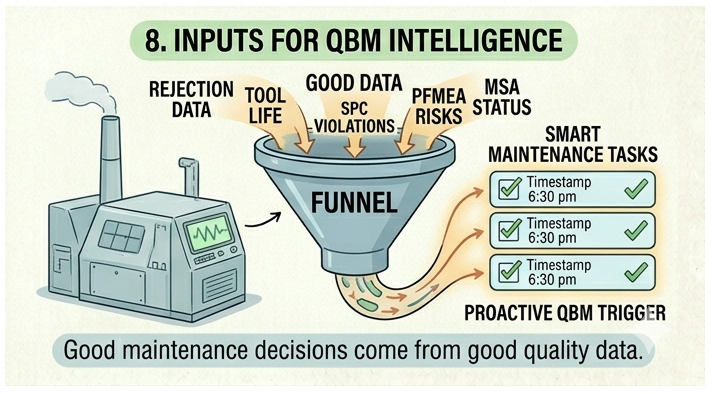
Key Inputs Required for QBM
QBM should be supported by reliable production, quality and maintenance data.
Typical inputs include:
- Machine-wise rejection data
- Rework and sorting records
- Customer complaint history
- Cp/Cpk trends
- SPC violations and trend shifts
- Tool life records
- Breakdown and downtime history
- Calibration and MSA status
- PFMEA risk levels
- Audit observations
- Maintenance records
- Operator observations
“Good maintenance decisions come from good quality data.”
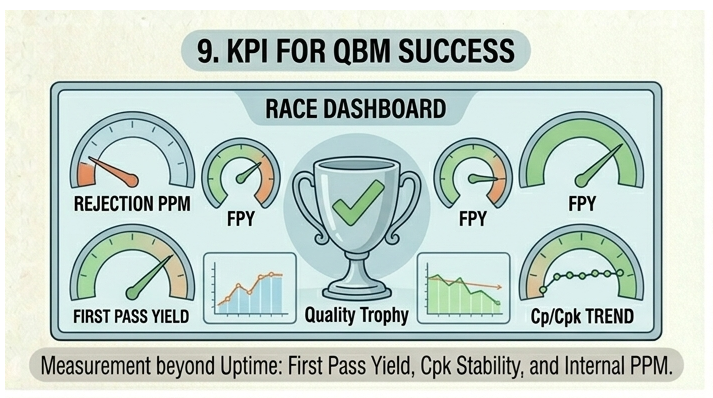
KPI for Quality Based Maintenance
QBM should be measured not only through uptime, but also through its impact on quality performance and process stability.
Typical KPI may include:
- Rejection rate by machine
- Rework rate by machine
- Customer complaints linked to machine
- Cp/Cpk trend
- First Pass Yield (FPY)
- SPC out-of-control events
- Internal PPM by machine
- Sorting incidents linked to machine
- Operator adjustment frequency
- Downtime due to quality issues
- Cost of Poor Quality by machine
- Percentage of special characteristic machines covered under QBM
- Quality escapes from QBM machines
- Maintenance effectiveness after action taken
“The true measure of maintenance is not machine uptime. It is stable quality output.”
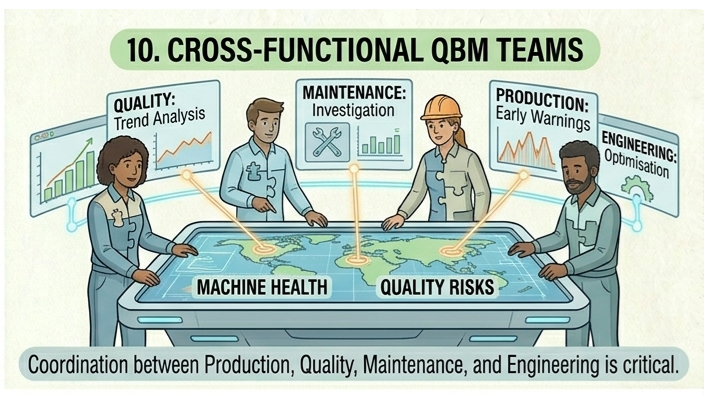
Roles and Responsibilities
Successful QBM requires coordination between production, quality, maintenance and engineering teams.
- Production should identify abnormal machine behaviour, frequent adjustments and early signs of variation
- Quality should analyse rejection trends, process capability, customer complaints and defect patterns
- Maintenance should investigate machine conditions, plan corrective actions and verify machine stability
- Engineering should support root cause analysis, parameter optimisation and process improvement
- Management should review trends, allocate resources and ensure QBM is applied to critical machines
“Quality Based Maintenance cannot be owned by one department alone. It requires cross-functional ownership.”
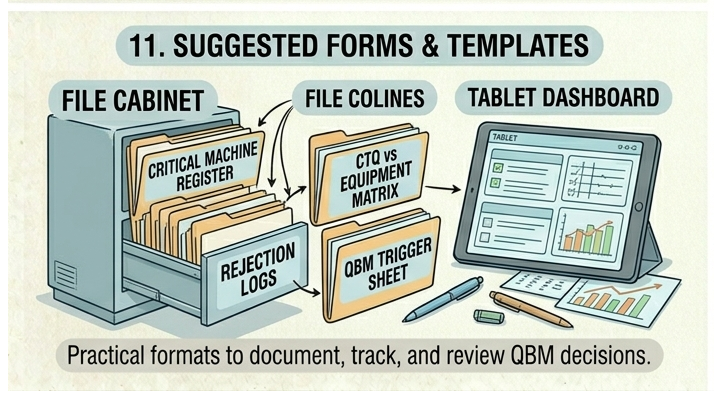
Suggested Forms and Templates
To make QBM practical and sustainable, organizations should support it with simple and structured formats.
Useful templates may include:
- Critical Machine Register
- Machine-Defect Correlation Matrix
- CTQ vs Equipment Condition Matrix
- Quality Trigger Escalation Sheet
- Tool Life Monitoring Sheet
- Maintenance Effectiveness Verification Form
- Rejection Trend Linked Maintenance Log
- Machine-wise QBM Dashboard
These formats help teams move from reactive maintenance to data-based decision making.
“If QBM is not documented, tracked and reviewed, it will remain only a concept.”
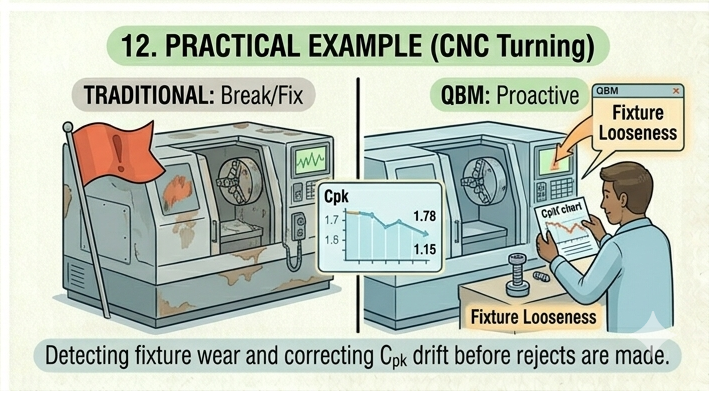
Practical Example
Consider a CNC turning machine producing a critical bore diameter.
The machine availability may still be above 90%, but gradual tool wear and fixture looseness can increase variation over time. Operators may start making frequent offset corrections, rejection may increase and Cp/Cpk may begin to fall.
In one such case, machine uptime remained stable, but Cpk dropped from 1.78 to 1.05 because fixture wear was not monitored.
Under traditional maintenance, the machine would still be considered healthy because it had not broken down.
Under QBM, the reduction in process capability, increase in rejection and repeated operator adjustment would trigger maintenance action much earlier.
“A machine can be available and still be incapable.”
Quality Based Maintenance is not about maintaining every machine more frequently. It is about maintaining the right machines at the right time based on their impact on product quality and process capability.
A machine may continue to run, but if it starts creating variation, rework, customer complaints or process instability, it is already becoming a quality risk.
Organizations that link maintenance with special characteristics, rejection trends, SPC, process capability and customer complaints can move from reactive maintenance to proactive quality protection.
“Maintenance should not only keep the machine running. It should keep the process capable.”
If your organization is looking to implement Quality Based Maintenance, develop templates or build a structured QBM framework, feel free to connect at ikhan@omnex.com.