Introduction
Most organizations say they have error-proofing.
But when we go to the shopfloor, we often find something different.
A sensor is installed. A checklist is added. A warning light is provided. An operator is trained. A quality gate is created.
Then everyone believes the risk is controlled.
But one important question is often missed:
Can the process still move forward when the wrong condition exists?
If the answer is yes, then the organization may not have strong error-proofing. It may only have better detection.
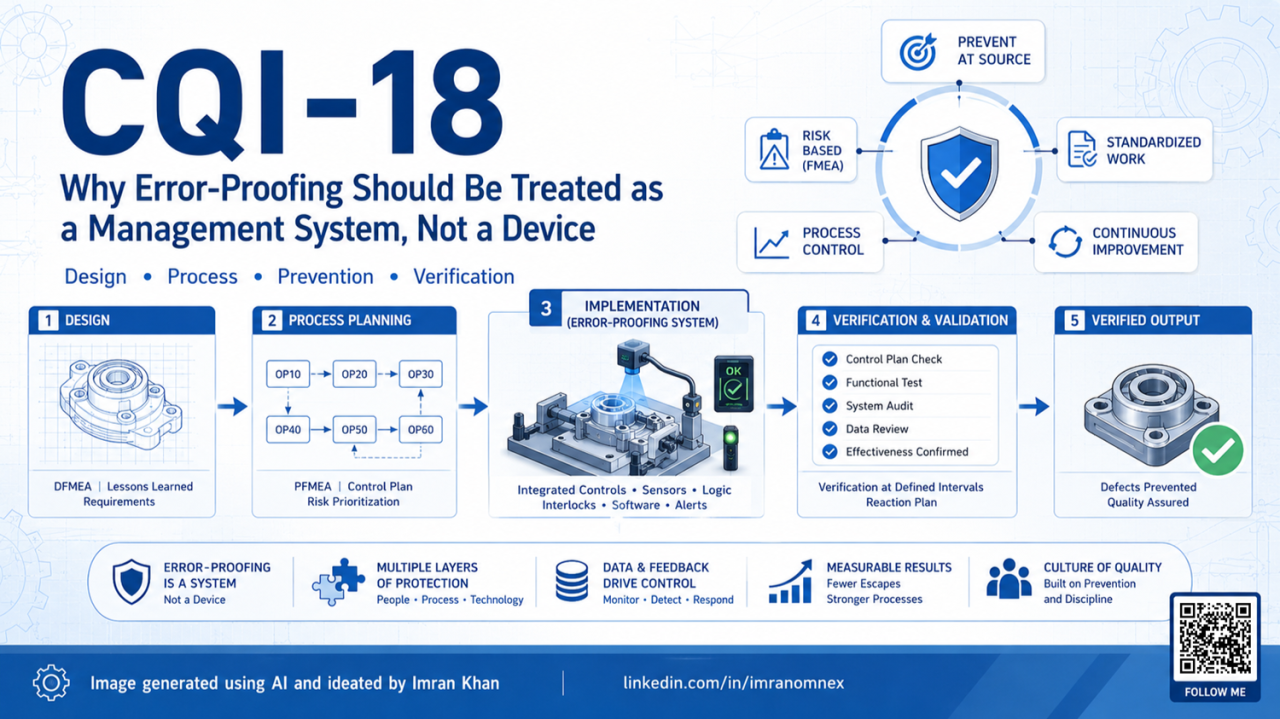
This is where CQI-18, Guideline to Effective Error-Proofing, becomes very important. It does not treat error-proofing as only a poka-yoke device. It presents error-proofing as a wider system linked with culture, product design, process planning, FMEA, standardized work, control plans, verification, and continual improvement.
The real message is simple:
Error-proofing is not proof that a device exists. It is proof that the process cannot quietly accept the wrong condition.
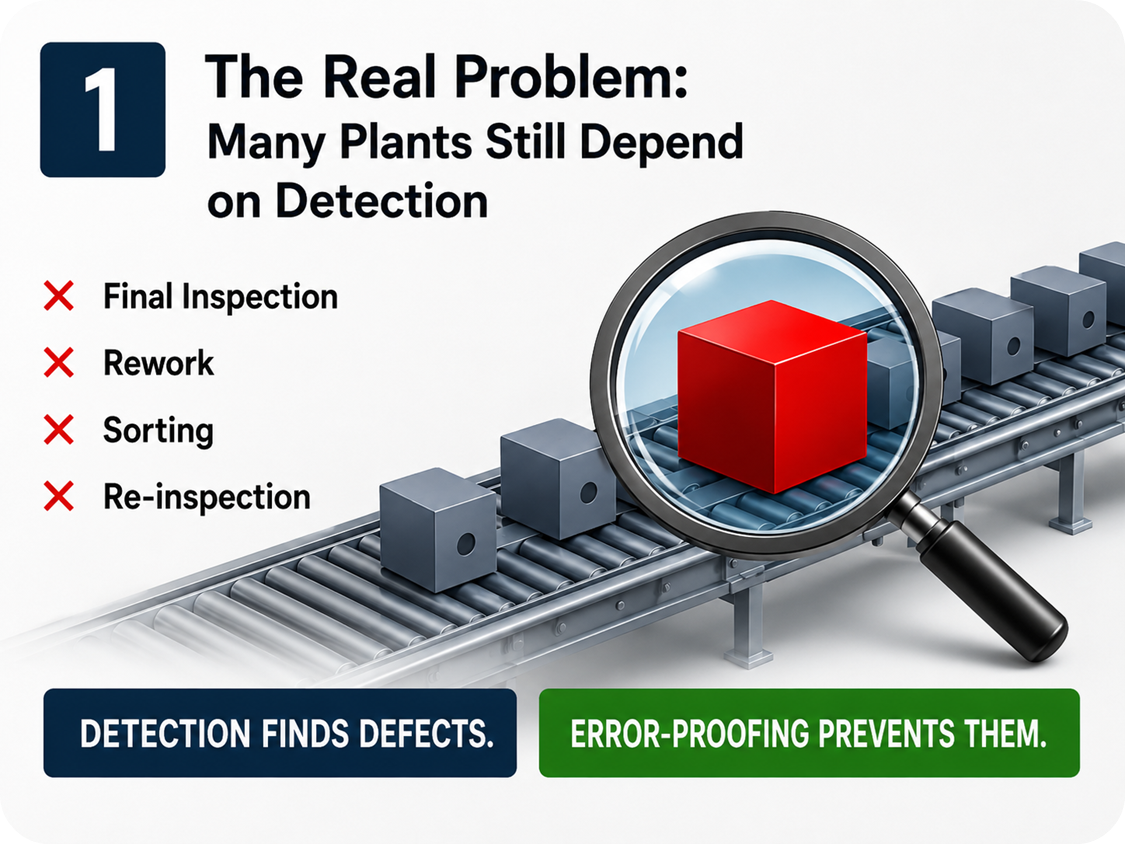
The Real Problem: Many Plants Still Depend on Detection
In many manufacturing plants, the quality system is still heavily dependent on detection.
The organization may have:
- Final inspection
- Patrol inspection
- Re-inspection
- Sorting
- Quality gates
- Customer containment
- Extra verification after complaints
These activities are useful in some situations, but they do not remove the source of the error.
Detection tells us that something went wrong.
Error-proofing should stop the wrong thing from happening, or at least stop it from moving forward.
That is a very important difference.
A detection-based system asks:
Did we find the defect?
A prevention-based system asks:
Why was the process allowed to create or pass the defect?
CQI-18 pushes organizations to move from the first question to the second question.
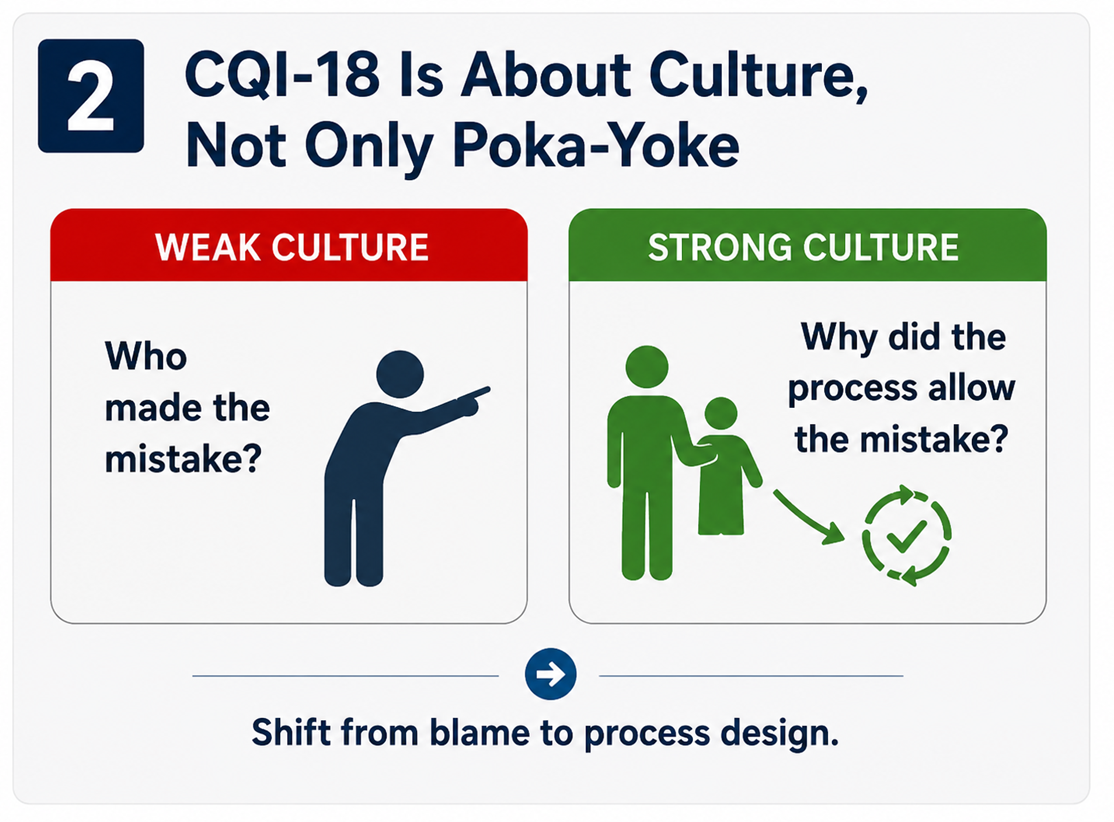
CQI-18 Is About Culture, Not Only Poka-Yoke
Many people use the word poka-yoke whenever they see a sensor, fixture, scanner, or interlock.
But CQI-18 takes a broader view.
The guide connects error-proofing with the idea of building a zero-error culture. This does not mean humans will never make mistakes. It means the system should be designed so that common mistakes are prevented, detected early, or stopped before reaching the customer.
This is a cultural change.
In a weak culture, the response to error is:
Who made the mistake?
In a mature culture, the response is:
Why did the process allow the mistake?
That shift is powerful.
It moves the organization away from blame and toward process design.
It also changes the role of leadership. Error-proofing cannot be left only to operators or quality inspectors. It needs involvement from design, manufacturing engineering, production, maintenance, quality, logistics, suppliers, and management.
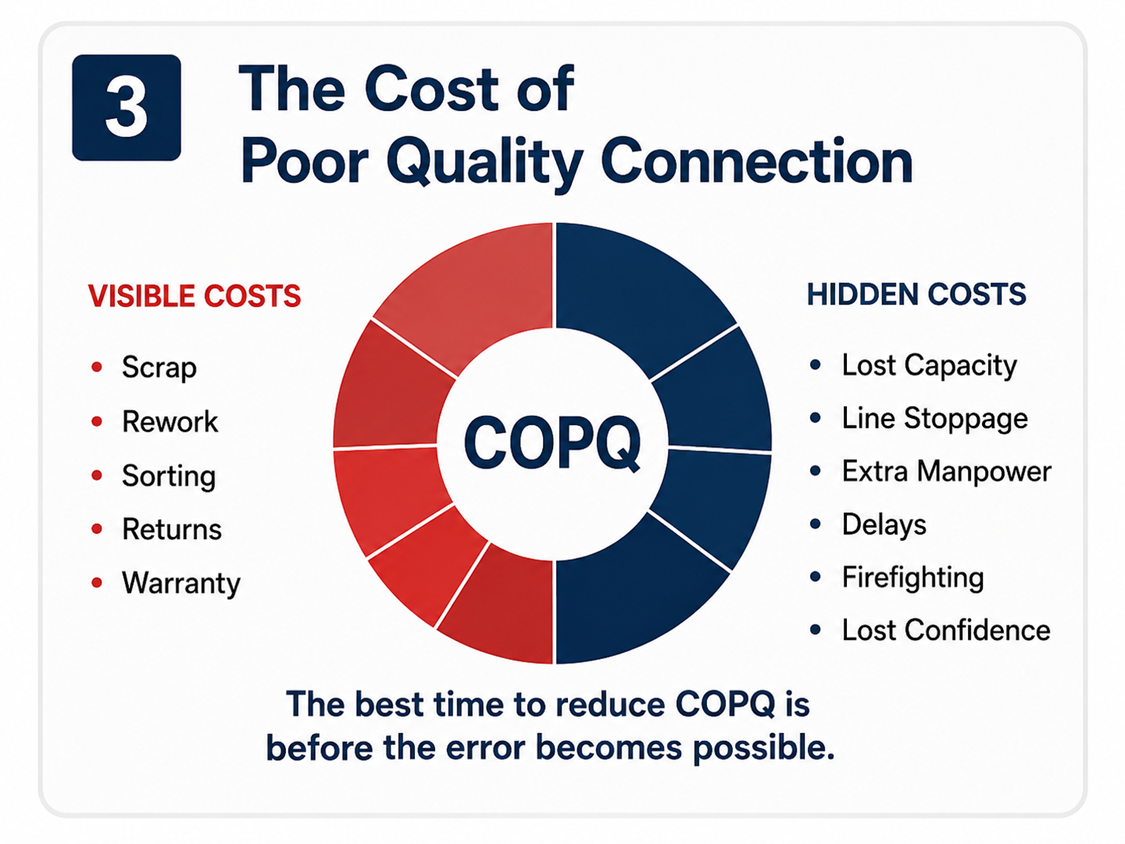
The Cost of Poor Quality Connection
Poor error-proofing creates cost everywhere.
Some costs are visible:
- Scrap
- Rework
- Sorting
- Re-inspection
- Customer returns
- Warranty claims
But many costs are hidden:
- Lost capacity
- Line stoppage
- Extra manpower
- Delayed dispatches
- Repeated meetings
- Firefighting
- Loss of customer confidence
- Management time spent on avoidable issues
This is why CQI-18 has a strong connection with the cost of poor quality. The guide explains cost categories such as prevention, appraisal, internal failure, and external failure. It also emphasizes that measuring quality cost helps organizations identify where poor quality is coming from and where improvement should be focused.
A company may think it is saving money by avoiding preventive controls.
But in reality, it may be paying much more through hidden losses.
The best time to reduce poor quality cost is not after the defect is produced.
It is before the error becomes possible.
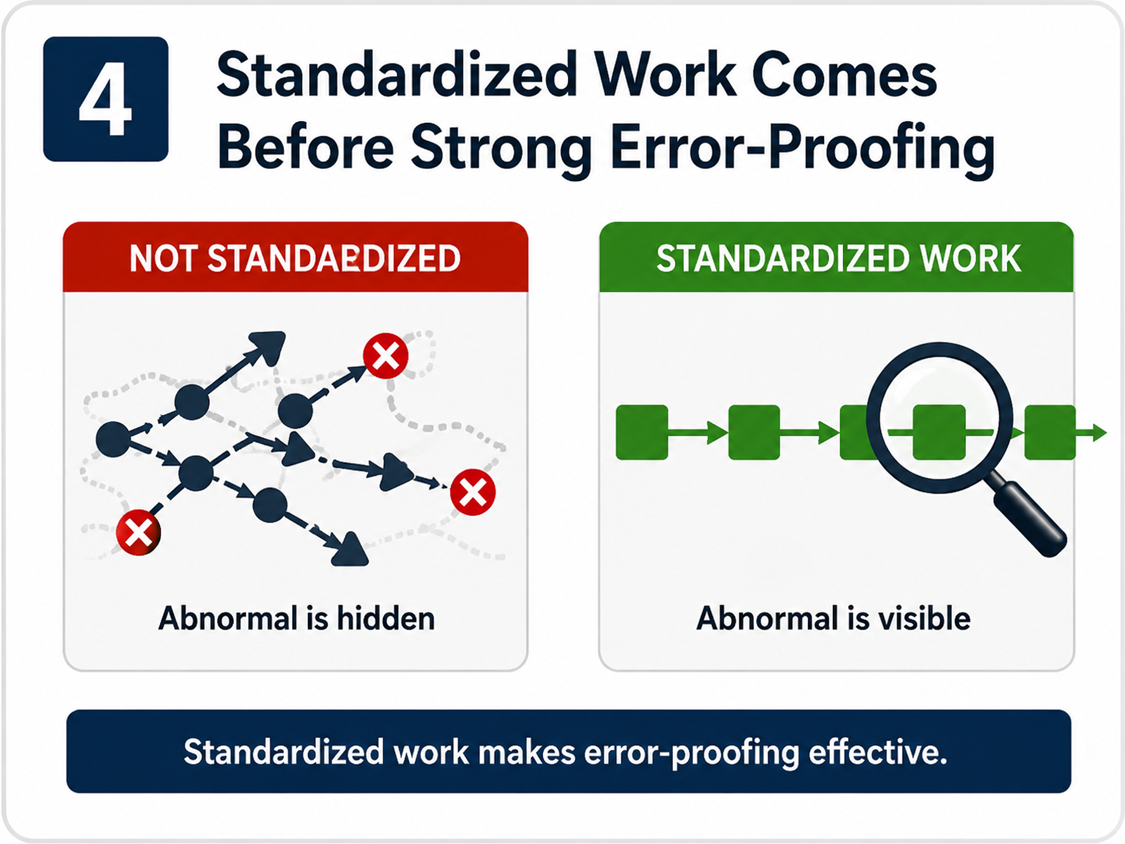
Standardized Work Comes Before Strong Error-Proofing
This is one of the most practical lessons from CQI-18.
If the work method is not standardized, error-proofing becomes weak.
Why?
Because error-proofing works best when the correct method is clearly defined.
If every shift works differently, every operator loads parts differently, every line uses a different sequence, or every supervisor accepts a different reaction, then the abnormal condition becomes difficult to see.
Standardized work defines:
- The correct sequence
- The expected method
- The normal condition
- The abnormal condition
- The reaction when something goes wrong
Only after this foundation is clear can error-proofing become effective.
A sensor installed on an unstable process may only detect variation. A checklist added to a non-standard process may only create paperwork. A warning light in a poorly controlled process may only become background noise.
So before asking, “Which poka-yoke should we install?” The better question is:
Is the process stable enough for error-proofing to work?
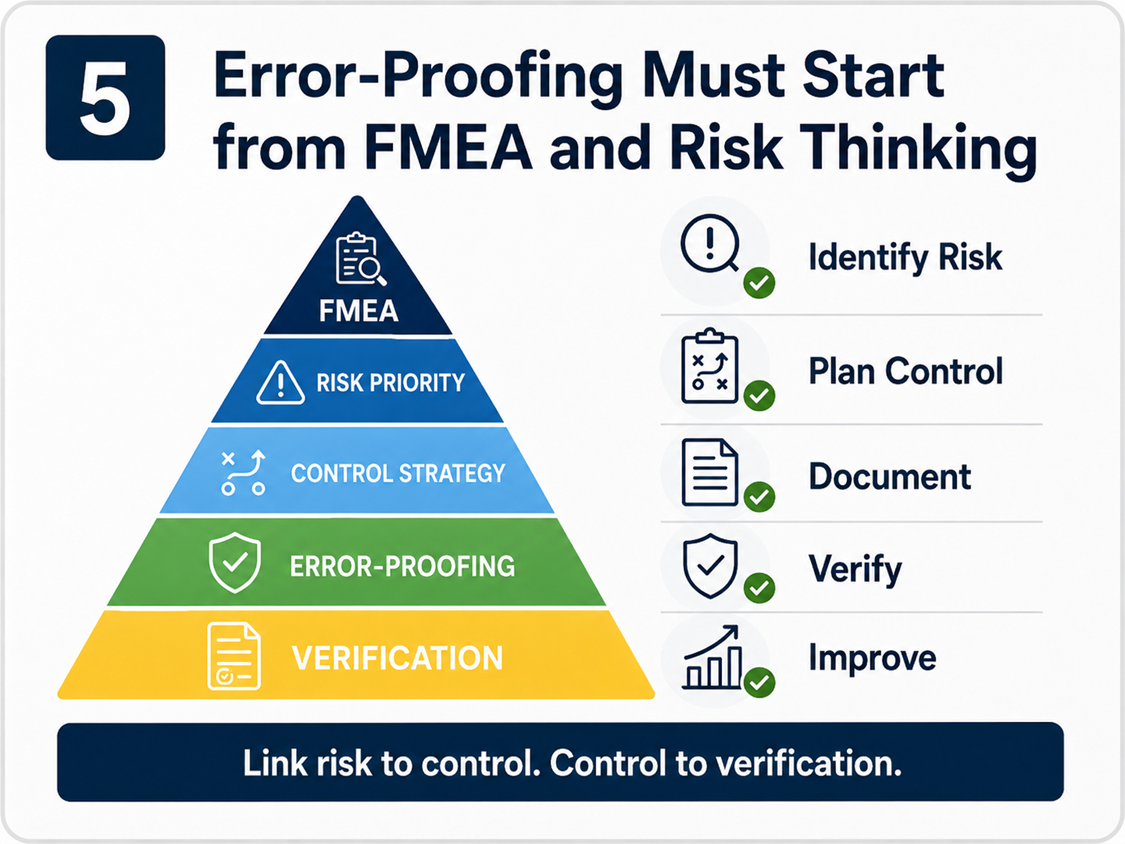
Error-Proofing Must Start from FMEA and Risk Thinking
Error-proofing should not be random.
It should be driven by risk.
CQI-18 clearly connects error-proofing with FMEA and risk assessment. The guide highlights that FMEA helps identify where error-proofing is needed, especially where failure modes have safety, regulatory, occurrence, or detection concerns.
This is very important for automotive organizations.
A practical flow should look like this:
DFMEA or PFMEA identifies the risk The team decides whether prevention or detection control is required The control is built into product design or process design The control is documented in the control plan The verification method and frequency are defined The reaction plan is clearly stated Lessons learned are captured for future programs
Without this linkage, error-proofing becomes isolated.
It may exist on the shopfloor, but it may not be connected to the risk analysis.
That is dangerous.
If an error-proofing device is controlling a high-risk failure mode, then it should be visible in the PFMEA and control plan. It should also have a defined verification method, frequency, responsibility, and reaction plan.
Otherwise, the organization may not know whether the control is still effective.
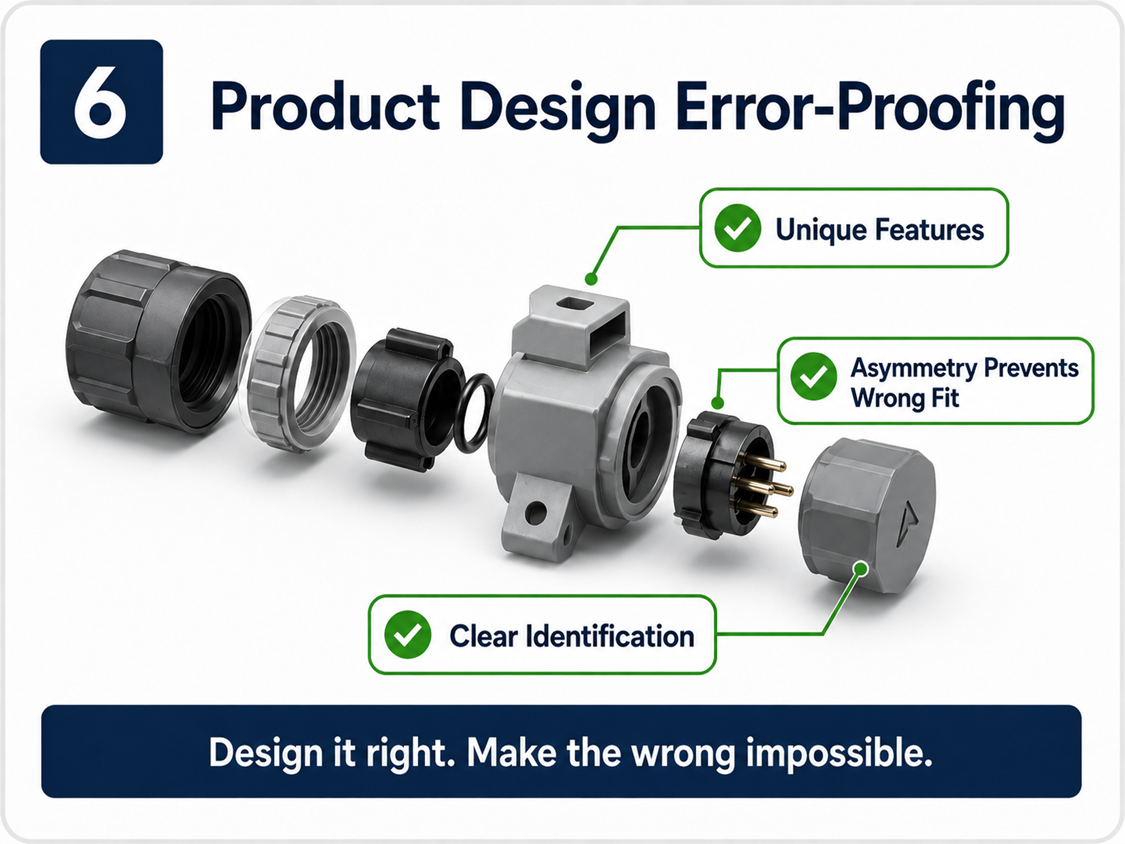
Product Design Error-Proofing: The Best Control Is Often Designed Early
Many manufacturing errors are created long before manufacturing starts.
They are created during product design.
If two parts look similar, wrong assembly becomes easier. If orientation is not controlled, reverse fitment becomes possible. If connector design allows wrong mating, the error becomes possible. If parts are difficult to handle, operator mistakes increase. If the product has unnecessary complexity, the process becomes harder to control.
CQI-18 gives major importance to product design error-proofing. The guide explains that design can remove or reduce opportunities for manufacturing error. It also links product design thinking with DFMEA, design for assembly, design for manufacturability, lessons learned, standards, benchmarking, warranty, and simultaneous engineering.
This is a key point.
The cheapest error-proofing is not always a device added later.
Sometimes the best error-proofing is a design decision that makes the wrong assembly impossible.
For example:
- A part that fits only in one direction
- A connector that cannot be wrongly connected
- A left-hand and right-hand part that are clearly different
- A design that reduces manual adjustment
- A shape that prevents wrong loading
- A feature that makes missing assembly immediately visible
This is why design teams and manufacturing teams must work together early.
If error-proofing starts only after customer complaints, the organization is already late.
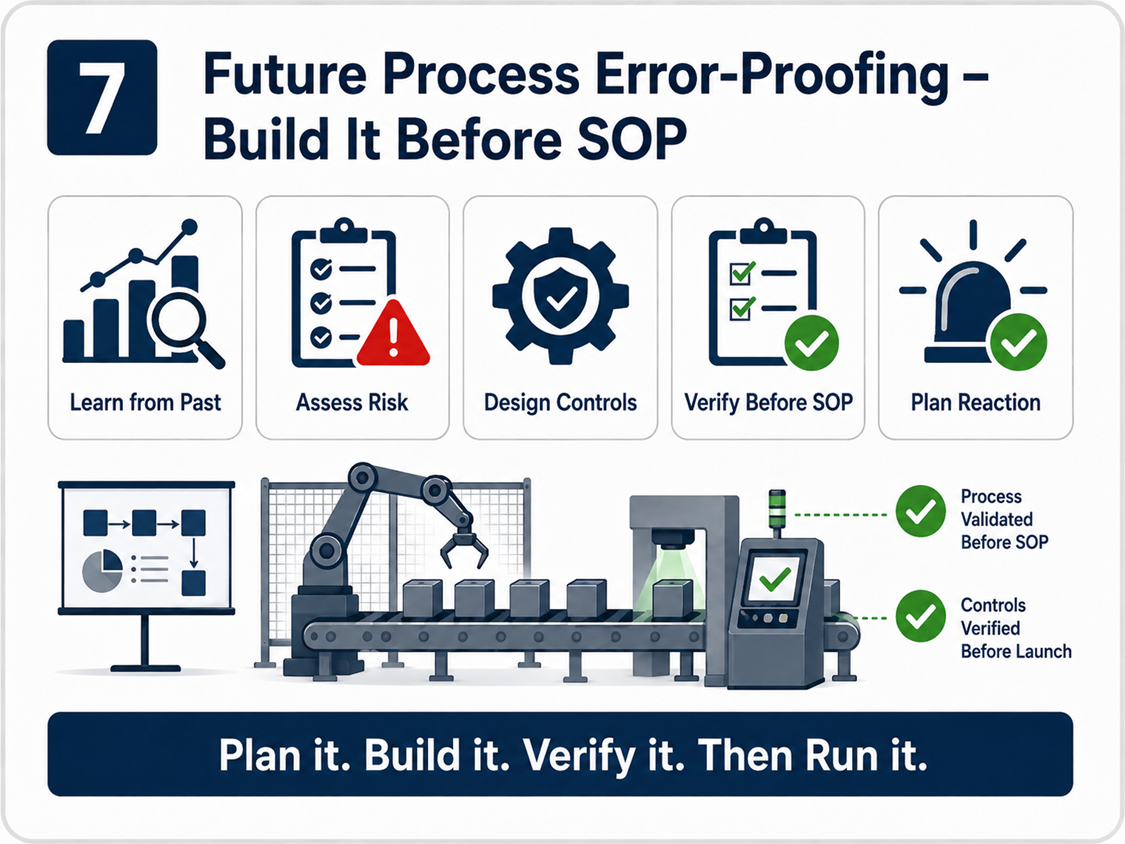
Future Process Error-Proofing: Build It Before SOP
Many organizations apply error-proofing only after defects occur.
That is reactive.
CQI-18 encourages a better approach for future processes.
For new lines, new equipment, new products, or new manufacturing processes, error-proofing should be considered before launch.
This includes:
- Reviewing lessons learned from similar products
- Studying past complaints and warranty issues
- Reviewing PFMEA risks
- Defining process controls early
- Building error-proofing into fixtures, tools, gauges, and software
- Verifying effectiveness before SOP
- Defining reaction plans before production begins
This is where APQP thinking becomes important.
During process design, the team should not only ask:
Can we manufacture this part?
They should also ask:
Can this process produce or pass a defect without knowing it?
If yes, the process still needs work.
Future process error-proofing is usually cheaper than retrofitting devices after launch.
It also reduces launch risk, customer complaints, containment cost, and firefighting.
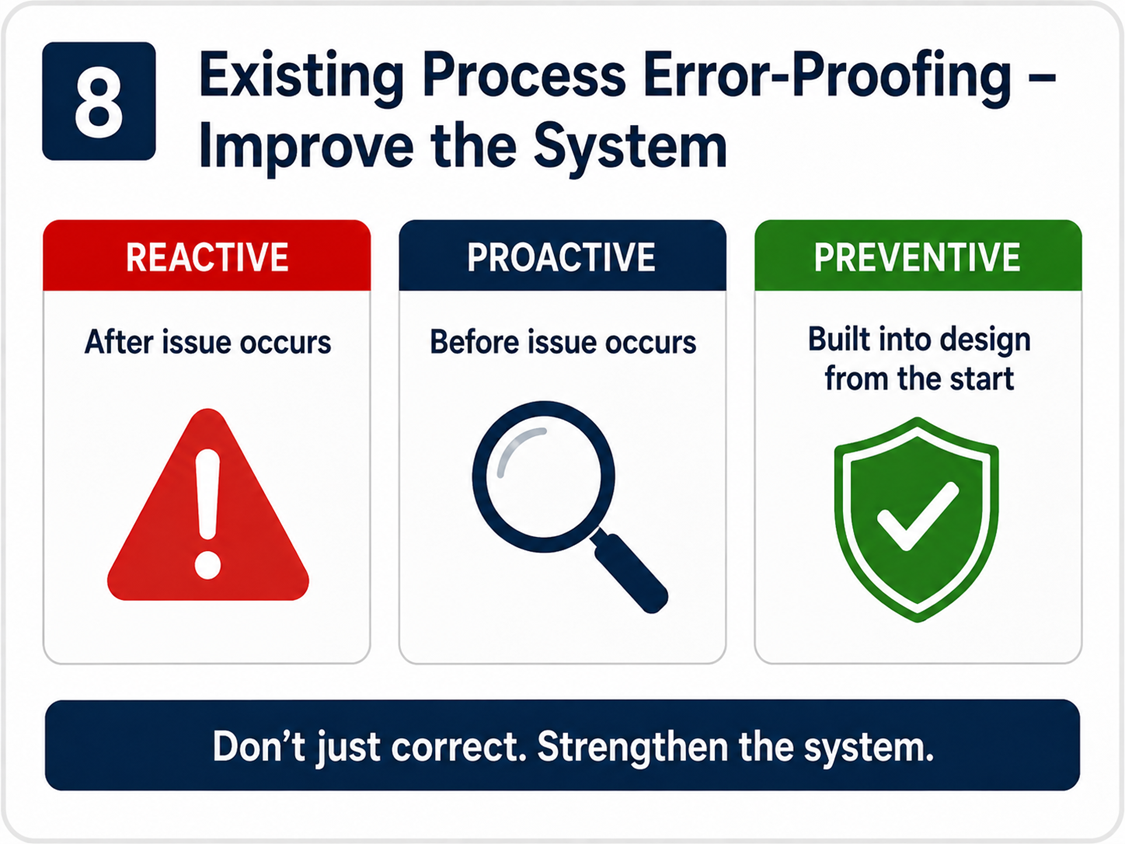
Existing Process Error-Proofing: Do Not Only Correct, Improve the System
Existing processes will always have problems.
A customer complaint happens. A defect escapes. A line stoppage occurs. A wrong part is assembled. A label is mixed. A test is skipped. A part is packed incorrectly.
The usual response is corrective action.
But CQI-18 encourages teams to think deeper.
The question is not only:
How do we correct this issue?
The better question is:
How do we prevent this type of error from happening again?
For existing processes, error-proofing can be reactive, proactive, or preventive.
Reactive error-proofing is done after the issue occurs. Proactive error-proofing is done before the issue occurs, based on risk or trend. Preventive error-proofing is built into the design of the product or process from the beginning.
For existing processes, a practical approach can be:
- Study the actual defect
- Understand where the error was introduced
- Identify where it should have been stopped
- Review the PFMEA and control plan
- Check whether current controls are prevention, detection, or only warning
- Decide whether the process can be changed
- Verify the effectiveness of the new control
- Update documentation
- Share lessons learned
A good corrective action does not only close the complaint.
It should make the process stronger.
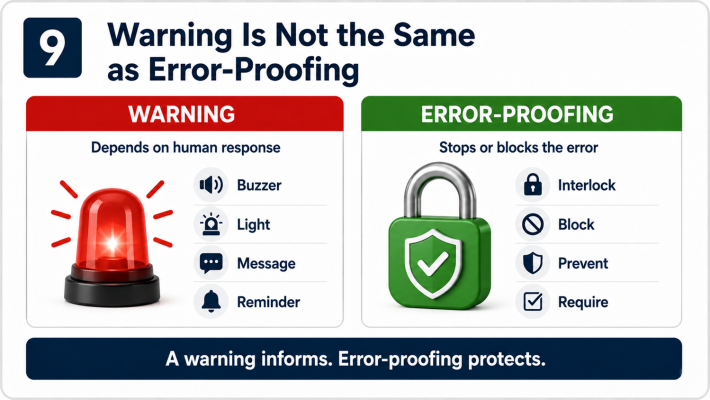
Warning Is Not the Same as Error-Proofing
This distinction is very important.
Many controls only warn the operator.
For example:
- Buzzer
- Light
- Display message
- Checklist reminder
- Instruction board
- Manual confirmation
These may help, but they may still allow the process to continue.
A warning depends on human response.
If the operator ignores it, misunderstands it, or is under production pressure, the error may still pass.
Stronger controls are different.
They prevent the wrong action or stop the next step.
For example:
- Part cannot be loaded in the wrong orientation
- Machine cycle does not start unless the part is correctly positioned
- Barcode mismatch blocks the operation
- Fixture does not close if the wrong part is present
- System does not allow label printing without correct data
- Assembly cannot move forward if torque is not achieved
- Test failure automatically holds the product
This is the maturity difference.
A warning says:
Something may be wrong. Please check.
A strong error-proofing system says:
Something is wrong. The process cannot continue.
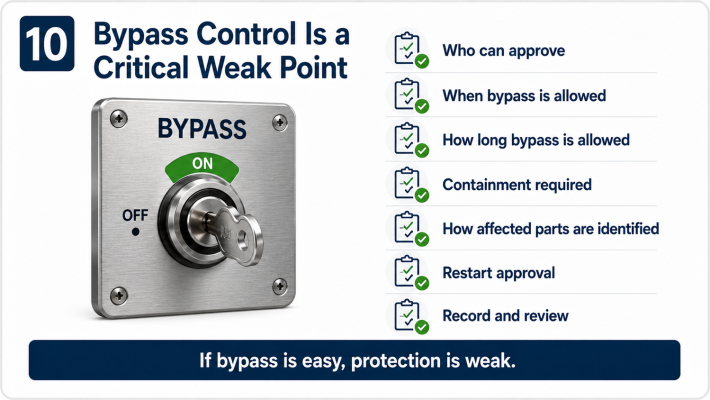
Bypass Control Is a Critical Weak Point
Even a good error-proofing device can fail if bypass is not controlled.
This is one of the most common shopfloor weaknesses.
The device exists. The control plan mentions it. The audit checklist verifies it. But during actual production, it can be bypassed.
Sometimes bypass is used because:
- The sensor is giving false alarms
- Maintenance is waiting
- Production pressure is high
- The device is not practical
- The operator has found a shortcut
- The supervisor wants output
- The reaction plan is not clear
This is a serious risk.
A mature error-proofing system should define:
- Who can approve bypass
- When bypass is allowed
- How long bypass is allowed
- What containment is required
- How affected parts will be identified
- Whether 100 percent inspection is needed
- How restart will be approved
- What record must be maintained
- Whether PFMEA and control plan need review
If bypass is not controlled, the organization may have only a paper control.
The process may look protected, but the customer may still be exposed.
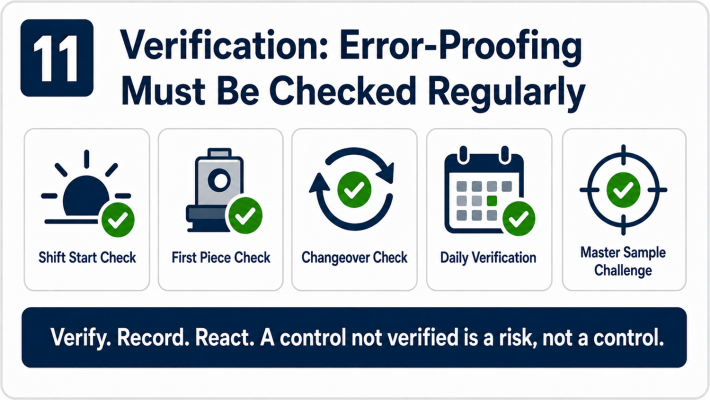
Verification: Error-Proofing Must Be Checked Regularly
An error-proofing device is not effective forever just because it was installed once.
Sensors fail. Fixtures wear out. Software logic changes. Master samples get damaged. Operators change. Product variants increase. Maintenance activities disturb settings. Process changes create new risks.
Therefore, verification is essential.
Verification should answer:
Is the error-proofing control still working as intended?
This may include:
- Shift-start checks
- First-piece checks
- Changeover checks
- Daily verification
- Red rabbit checks
- Master sample challenge
- Preventive maintenance checks
- Layered process audit checks
- Software logic verification
- Control plan confirmation
The verification frequency should be risk-based.
A high-risk control should not be checked casually.
It should have a clear method, clear frequency, clear acceptance criteria, and clear record.
Most importantly, there should be a reaction plan when the verification fails.
Because discovering that error-proofing is not working is not the end of the process.
It is the start of containment.
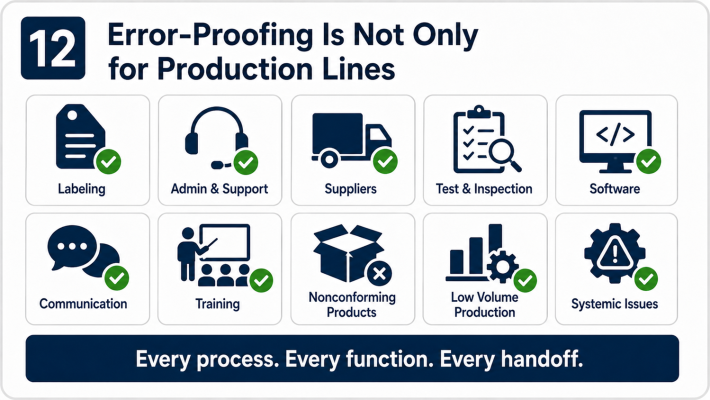
Error-Proofing Is Not Only for Production Lines
Many people think error-proofing is only for assembly or machining operations.
CQI-18 takes a much wider view.
The guide includes special considerations such as labeling, administrative and support functions, suppliers, nonconforming products, special causes, test and inspection, low-volume production, software, communication, training, and systemic issues.
This is very useful because many serious errors do not start at the machine.
They may start in:
- Label printing
- Order entry
- Drawing revision control
- ERP master data
- Packaging selection
- Supplier part identification
- Test report preparation
- Dispatch documentation
- Engineering change communication
- Customer-specific requirement review
A wrong label can create a customer complaint. Wrong revision data can create a manufacturing escape. Wrong packaging can damage parts. Wrong software version can affect product performance. Wrong supplier identification can lead to mix-up.
So error-proofing should also be applied to support processes.
A mature organization does not ask only:
Where can the operator make a mistake?
It asks:
Where can the system allow wrong information, wrong material, wrong decision, or wrong product to move forward?
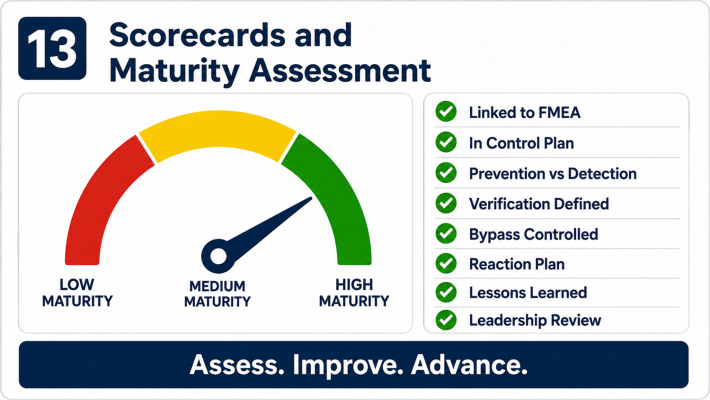
Scorecards and Maturity Assessment
One of the useful aspects of CQI-18 is that it does not stop at concepts.
It also includes scorecards and assessment approaches for areas such as plant error-proofing, continuous process error-proofing, manufacturing process error-proofing, administrative processes, and design error-proofing.
This is important because error-proofing needs maturity assessment.
Otherwise, the organization may have many isolated devices but no system.
A maturity review should check:
- Is error-proofing linked to FMEA?
- Is it included in the control plan?
- Is verification frequency defined?
- Is bypass controlled?
- Is reaction plan clear?
- Are lessons learned reused?
- Are suppliers included?
- Are support processes considered?
- Are employees trained?
- Are improvements measured?
- Is leadership reviewing effectiveness?
Without assessment, error-proofing becomes invisible until it fails.
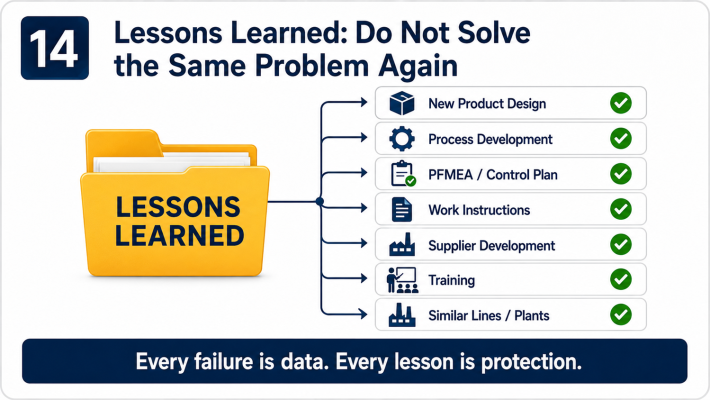
Lessons Learned: Do Not Solve the Same Problem Again
Every customer complaint should teach the organization something.
Every escaped defect should improve the system.
Every internal failure should become a lesson for future products and processes.
But in many organizations, lessons learned are weak.
They remain in 8D reports, PowerPoint files, or meeting minutes.
They do not reach:
- New product design
- New process development
- PFMEA updates
- Control plan updates
- Work instruction updates
- Supplier development
- Training material
- Similar lines
- Similar products
- Future APQP reviews
CQI-18 gives importance to lessons learned because error-proofing should improve over time.
If the same type of error happens again in another line, another plant, or another product, then the organization did not really learn.
It only corrected.
A strong error-proofing culture uses every failure as input for future prevention.
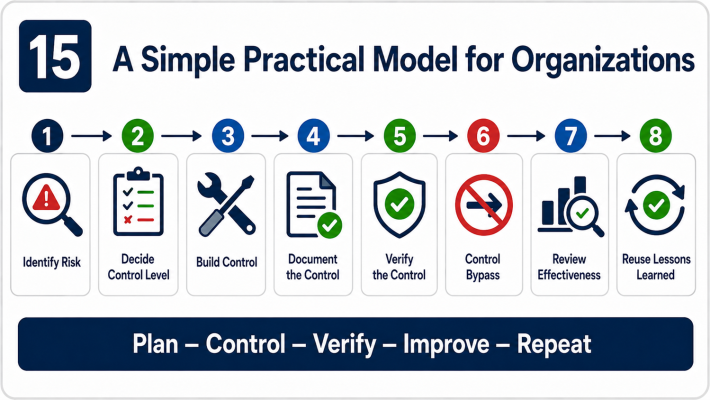
A Simple Practical Model for Organizations
For practical implementation, organizations can use a simple model:
Step 1: Identify risk
Use DFMEA, PFMEA, complaints, warranty, scrap, rework, sorting, audit findings, and operator feedback.
Step 2: Decide the control level
Ask whether prevention is possible. If prevention is not possible, decide how detection will stop the next step. Avoid relying only on warnings where risk is high.
Step 3: Build the control into the process
Use product design, fixture design, machine logic, sensors, software, interlocks, barcode control, vision systems, or physical prevention.
Step 4: Document the control
Update PFMEA, control plan, work instructions, maintenance plan, and reaction plan.
Step 5: Verify the control
Define method, frequency, responsibility, acceptance criteria, and record.
Step 6: Control bypass
Define approval, containment, restart, and escalation.
Step 7: Review effectiveness
Measure escapes, rework, sorting, stoppages, audit findings, and repeated failures.
Step 8: Reuse lessons learned
Apply the learning to similar products, processes, suppliers, and future programs.
Ten Questions to Assess Your Error-Proofing Maturity
Here are ten simple questions every plant can ask:
- Are our error-proofing controls linked to PFMEA risks?
- Are they clearly included in the control plan?
- Do they prevent the error or only detect it?
- Can the process move forward when the error is present?
- Can the device be bypassed easily?
- Is bypass approval and containment defined?
- Is verification frequency defined and followed?
- Is there a clear reaction plan when verification fails?
- Are lessons learned used in new product and process design?
- Are support processes also error-proofed, or only production lines?
If the answer to many of these questions is weak, then the organization may not have an error-proofing system.
It may only have error-proofing devices.
Conclusion
CQI-18 gives a very practical reminder to manufacturing organizations.
Error-proofing is not about adding more inspection.
It is not about blaming operators.
It is not about installing devices only after customer complaints.
It is about designing a system where the wrong condition is prevented, detected early, stopped from moving forward, verified regularly, and improved continuously.
The goal is not to make people perfect.
The goal is to make the process strong enough to protect people, customers, and the organization from predictable errors.
In the end, the real test of error-proofing is not whether a sensor exists.
The real test is this:
Can the process quietly accept the wrong condition and still continue?
If yes, the work is not complete.
Because effective error-proofing is not a device.
It is a management system built on prevention, discipline, verification, and learning.
In your organization, is error-proofing treated as a system, or is it still limited to sensors, checklists, and inspection points?