Most organizations define quality objectives as part of their Quality Management System. However, very few organizations systematically analyze what could prevent those objectives from being achieved. As a result, quality objectives often remain targets on dashboards rather than structured operational plans. Organizations monitor performance, review trends, and report results, but the risks that could lead to failure of these objectives are rarely examined in a structured manner.
Applying FMEA thinking to quality objectives offers a practical way to address this gap. By treating the objective as a requirement and considering failure to achieve the objective as a failure mode, organizations can systematically analyze potential causes, evaluate existing controls, and identify improvement actions. This approach transforms quality objectives from simple performance indicators into risk managed initiatives that drive meaningful improvement.
Why Traditional Quality Objective Deployment Falls Short
In many organizations quality objectives are defined during management review or annual planning exercises. Targets are assigned to functions and performance is monitored through monthly dashboards or management review meetings. While this approach helps track performance, it does not always ensure that the organization systematically understands the risks that could prevent the objective from being achieved.
For example an organization may define an objective such as increasing on time delivery to ninety six percent. The performance may be monitored every month, but the underlying factors that could lead to failure of this objective are often not analyzed in a structured way. Production capacity constraints, supplier delays, equipment downtime, or poor coordination between planning and dispatch functions may all influence delivery performance. If these risks are not evaluated early, corrective actions are usually reactive rather than preventive.
This is where applying FMEA thinking to quality objectives becomes useful. Instead of treating the objective only as a performance target, the objective is treated as a requirement. Failure to achieve the objective becomes the failure mode. The possible operational causes are then systematically analyzed along with existing controls and improvement actions.
Applying FMEA Thinking to Quality Objectives
Failure Mode and Effects Analysis is traditionally used in product design and process development to identify potential failures, understand their causes, and implement actions to reduce risk. The same structured thinking can also be applied to management system objectives.
In this approach the quality objective is treated as a requirement that the organization must achieve. Failure to meet the objective is considered the failure mode. The effects represent the impact on the customer or business when the objective is not achieved. The analysis then focuses on identifying the operational causes that could lead to this failure. Existing management system practices such as planning activities, monitoring mechanisms, and review processes act as prevention and detection controls.
By applying this logic, organizations can analyze the risks associated with achieving their objectives in a structured manner. Each potential cause is evaluated in terms of occurrence and detection, and appropriate improvement actions are defined along with responsible owners and target completion dates. This converts the objective from a simple performance target into a structured improvement initiative supported by risk analysis.
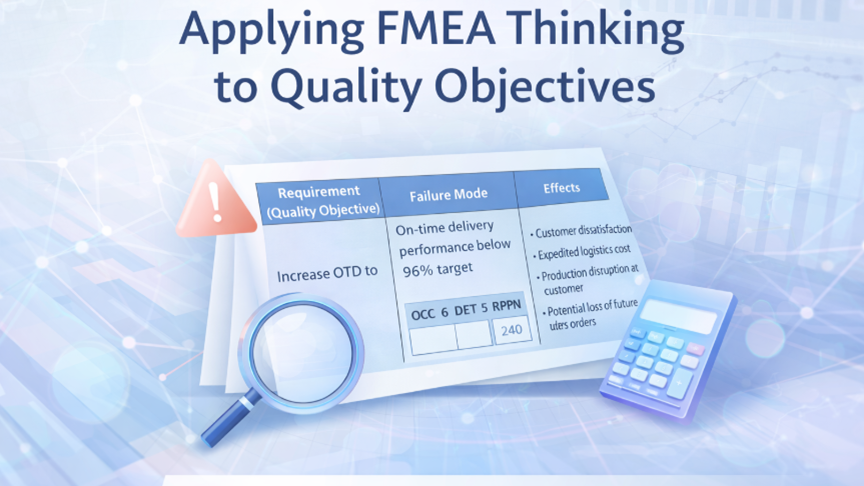
To illustrate this approach, the following example demonstrates how FMEA thinking can be applied to a common operational objective related to on time delivery performance.
Step 1. Define the Requirement, Failure Mode, and Effects
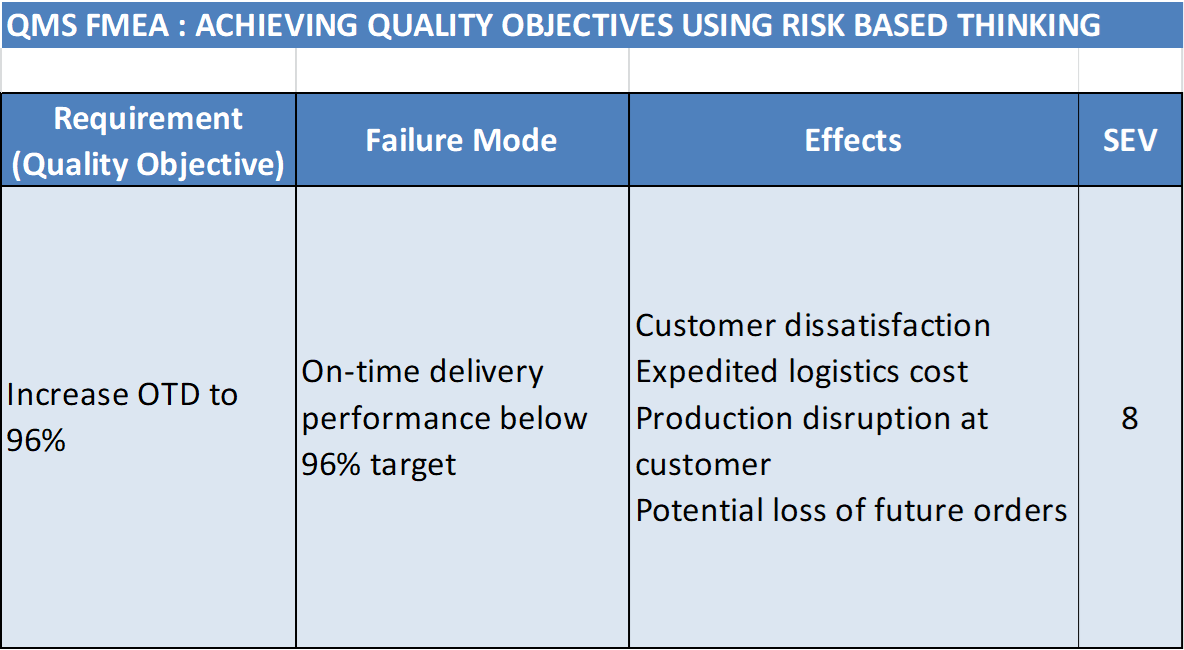
The first step in applying FMEA thinking to quality objectives is to clearly define the requirement and the potential failure mode. In this context, the quality objective itself becomes the requirement that the organization must achieve. Failure to achieve this objective is treated as the failure mode.
In the example shown, the objective is to increase On Time Delivery to ninety six percent. The failure mode therefore becomes on time delivery performance below the ninety six percent target.
Once the failure mode is defined, the next task is to identify the potential effects of this failure on the customer and the business. These effects help determine the severity of the failure. In this case, failure to meet the delivery objective may lead to customer dissatisfaction, expedited logistics costs, disruption of the customer’s production operations, and potential loss of future orders.
Based on the most serious potential impact, the severity rating is determined as eight. Establishing the requirement, failure mode, and effects creates the foundation for the rest of the analysis. The next step focuses on identifying the operational causes that could lead to this failure.
Step 2. Identify Causes and Existing Prevention Controls
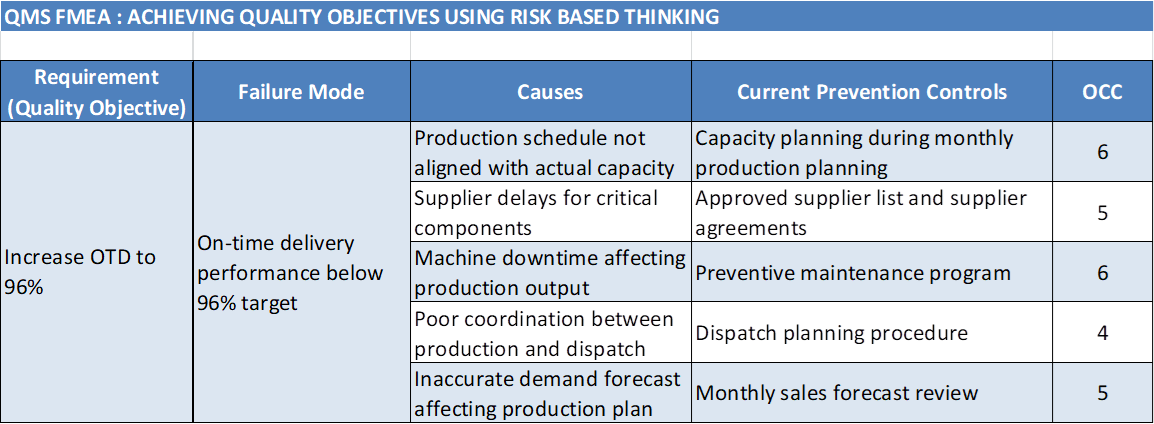
After defining the requirement, failure mode, and effects, the next step is to identify the operational causes that could lead to failure of the objective. These causes represent the underlying conditions within the organization that may prevent the objective from being achieved.
In the case of the on time delivery objective, several operational factors can influence delivery performance. Examples include production schedules that are not aligned with actual manufacturing capacity, delays from critical suppliers, machine downtime affecting production output, lack of coordination between production and dispatch activities, and inaccurate demand forecasts that lead to incorrect production planning.
Once these causes are identified, the next task is to examine the existing prevention controls already present within the management system. These controls represent practices or mechanisms that are intended to prevent the failure from occurring. Examples may include production planning activities, supplier management processes, preventive maintenance programs, dispatch planning procedures, and sales forecast reviews.
Each cause is then evaluated in terms of occurrence, which reflects the likelihood that the cause may occur under current operating conditions. Understanding both the causes and the existing prevention controls provides a realistic view of the risks associated with achieving the objective.
This step is critical because it moves the analysis from a general objective to the specific operational factors that influence performance. The next step focuses on identifying the mechanisms that help detect these issues before they impact the objective.
Step 3. Identify Detection Controls and Assess Detection Capability
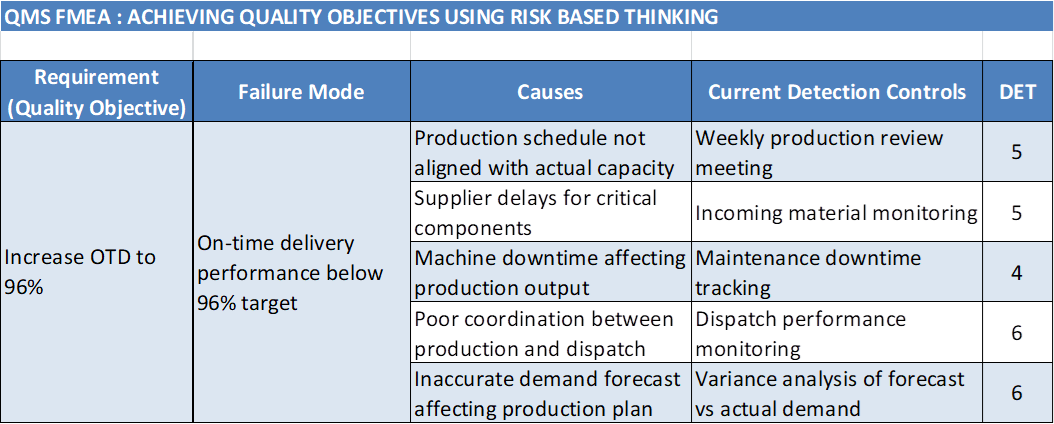
After identifying the causes and prevention controls, the next step is to evaluate the mechanisms that help detect potential issues before they impact the objective. These mechanisms are referred to as detection controls.
Detection controls represent monitoring or review processes within the management system that allow the organization to identify problems early. In the case of the on time delivery objective, several monitoring mechanisms already exist. These include weekly production review meetings to track scheduling performance, incoming material monitoring to identify supplier delays, maintenance downtime tracking to monitor equipment availability, dispatch performance monitoring to evaluate coordination between production and logistics, and variance analysis of forecast versus actual demand to identify planning inaccuracies.
Each of these detection controls is then evaluated using a detection rating, which reflects the ability of the control to identify the issue before it leads to failure of the objective. Lower detection ratings indicate stronger monitoring capability, while higher ratings indicate weaker detection mechanisms.
Evaluating detection controls provides insight into how effectively the organization can identify risks early and respond before they impact delivery performance. Combined with the occurrence ratings from the previous step, this information allows the organization to prioritize improvement actions.
The next step focuses on implementing improvement actions and reassessing the risk levels after these actions are introduced.
Step 4. Evaluate Risk Using Severity, Occurrence, and Detection
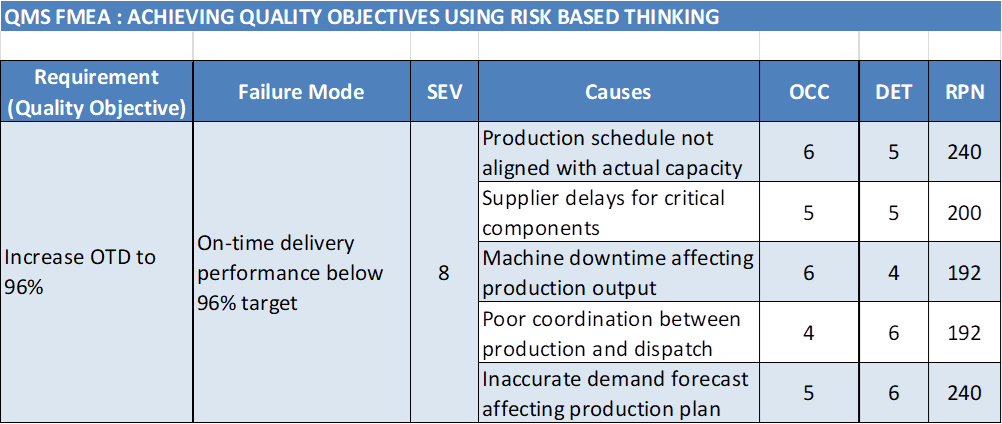
Once the causes, prevention controls, and detection mechanisms are identified, the next step is to evaluate the risk associated with each potential cause. This is done using the traditional FMEA approach based on three parameters: severity, occurrence, and detection.
Severity represents the seriousness of the impact if the failure mode occurs. In this example, the severity is determined based on the potential effects on the customer and the business, such as customer dissatisfaction, expedited logistics costs, disruption of the customer’s production, and potential loss of future orders. Based on these impacts, the severity rating is assigned as eight.
Occurrence represents the likelihood that a particular cause may occur under current operating conditions. For example, production scheduling issues, supplier delays, equipment downtime, coordination challenges between production and dispatch, and inaccurate demand forecasting each have different probabilities of occurrence depending on the organization’s processes and controls.
Detection reflects the ability of the current monitoring mechanisms to identify the issue before it leads to failure of the objective. Detection ratings are influenced by the effectiveness of activities such as production review meetings, supplier monitoring, maintenance tracking, dispatch performance monitoring, and forecast variance analysis.
By combining severity, occurrence, and detection ratings, the Risk Priority Number is calculated for each cause. The RPN provides a structured method to prioritize which issues require improvement actions. Higher RPN values indicate areas where the organization should focus its improvement efforts to ensure the quality objective can be achieved reliably.
The next step involves defining improvement actions and reassessing the risk levels after these actions are implemented.
Step 5. Define Improvement Actions, Responsibility, and Target Dates
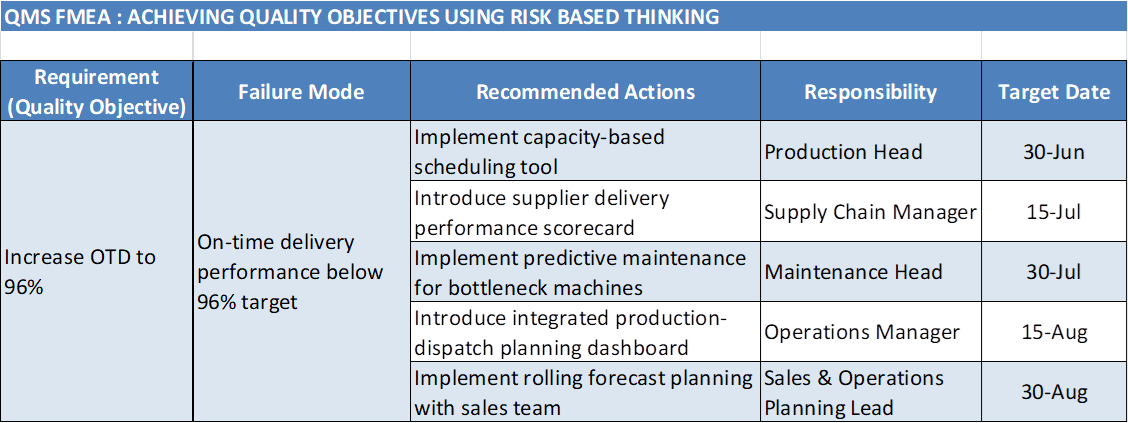
After evaluating the risks associated with each cause, the next step is to define improvement actions aimed at reducing the likelihood of occurrence or improving the ability to detect potential issues early. These actions should address the most significant risks identified through the RPN analysis.
In this example, several operational improvement actions are proposed to strengthen the system conditions required to achieve the on time delivery objective. These include implementing capacity based scheduling tools to better align production planning with actual manufacturing capability, introducing supplier delivery performance monitoring to improve supplier reliability, deploying predictive maintenance for bottleneck machines to reduce unplanned downtime, improving coordination between production and dispatch through integrated planning dashboards, and strengthening demand forecasting processes through structured rolling forecast planning.
An important aspect of this step is the assignment of clear ownership and accountability. Each action is assigned to a responsible function or role within the organization, along with a defined target completion date. This ensures that improvement initiatives are tracked and implemented in a timely manner.
By linking improvement actions directly to the risks identified in the analysis, the organization moves beyond monitoring objectives and begins to actively manage the conditions required to achieve them. Once these actions are implemented, the final step involves reassessing the risk levels to verify that the improvements have effectively reduced the risk associated with failing to achieve the objective.
Step 6. Evaluate Risk Reduction After Improvement Actions
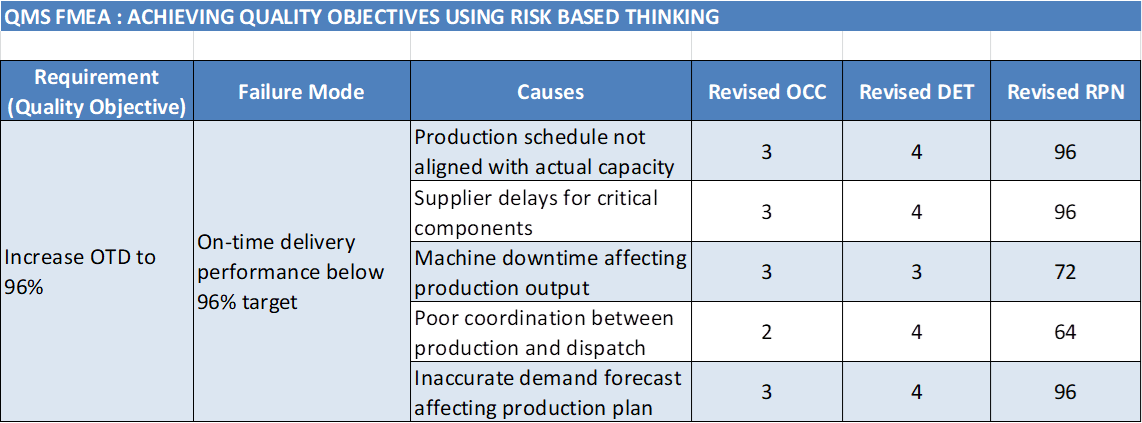
After identifying the causes, existing controls, and improvement actions, the final step is to evaluate how these actions reduce the risk associated with failing to achieve the objective. This is done by reassessing the occurrence and detection ratings after the recommended actions are implemented.
In the example shown, improvement actions such as implementing capacity based scheduling, introducing supplier delivery performance monitoring, deploying predictive maintenance for bottleneck machines, improving coordination between production and dispatch, and strengthening demand forecasting processes are expected to reduce the likelihood of occurrence and improve the ability to detect potential issues earlier.
By revising the occurrence and detection ratings, the Risk Priority Number is recalculated, providing a clear view of the expected reduction in risk. Lower RPN values indicate that the system conditions supporting the objective have improved and the likelihood of failing to achieve the objective has been reduced.
This step is important because it demonstrates that the objective is not only monitored but is also supported by structured improvement actions that reduce operational risks. The analysis therefore converts the quality objective from a simple performance target into a controlled and risk managed initiative.
Integrating QMS FMEA into the Management System
The example illustrates how FMEA thinking can be applied to analyze the risks associated with achieving a quality objective. However, the real value of this approach lies in integrating it into the broader Quality Management System.
In many organizations quality objectives are monitored primarily through performance dashboards and periodic management reviews. While this provides visibility into performance trends, it does not always ensure that the organization systematically evaluates the operational conditions required to achieve those objectives.
Applying FMEA thinking introduces a structured method for identifying the factors that influence objective achievement. By linking objectives with potential failure modes, operational causes, existing controls, and improvement actions, organizations can better understand the risks associated with their strategic targets.
This approach also strengthens the practical application of risk based thinking within ISO 9001. Clause 6.1 requires organizations to address risks and opportunities, while Clause 6.2 requires the establishment of measurable quality objectives. Using QMS FMEA provides a practical mechanism to connect these two requirements. The objective becomes the requirement, failure to achieve the objective becomes the failure mode, and operational risks are systematically analyzed using established FMEA principles.
As a result, quality objectives evolve from simple performance targets into structured improvement initiatives supported by clear actions, ownership, and monitoring mechanisms.
Conclusion
Quality objectives are an essential element of every Quality Management System, yet in many organizations they remain limited to performance indicators that are periodically reviewed and reported. While monitoring performance is important, it does not always ensure that the underlying risks affecting objective achievement are systematically analyzed and addressed.
Applying FMEA thinking to quality objectives provides a structured method to bridge this gap. By treating the objective as a requirement and failure to achieve the objective as the failure mode, organizations can analyze potential causes, evaluate existing controls, prioritize risks, and define targeted improvement actions. This approach enables organizations to move beyond simple performance tracking and instead manage the operational conditions that influence objective achievement.
Integrating this method within the management system also strengthens the practical implementation of risk based thinking required by ISO 9001. It provides a clear connection between identifying risks and opportunities and establishing quality objectives, ensuring that objectives are supported by structured analysis and improvement actions.
Ultimately, this approach transforms quality objectives from dashboard targets into risk managed initiatives that drive continuous improvement and operational reliability.