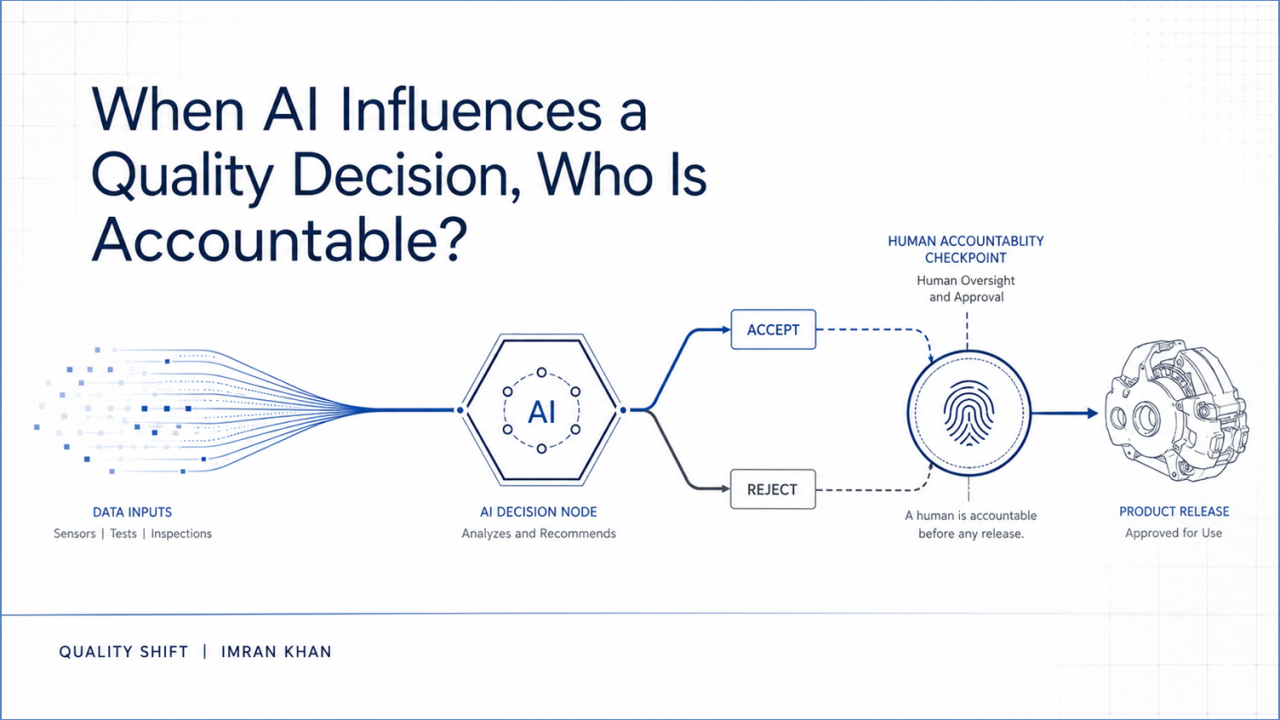
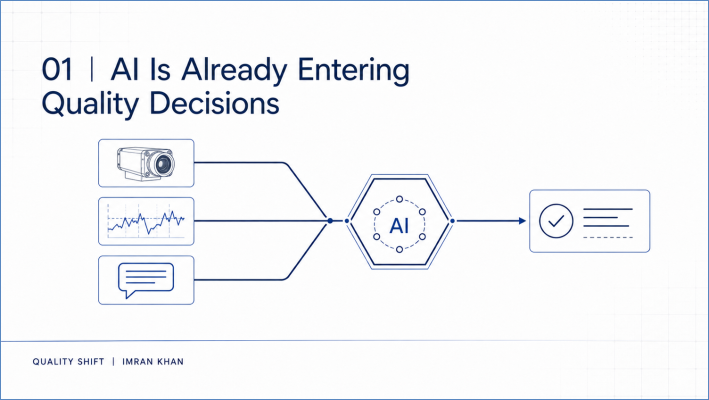
An inspection camera captures an image of a component. Sensors provide process data. Test equipment supplies results. Historical records offer patterns from previous failures.
An AI system analyses these inputs and recommends one of two decisions:
ACCEPT or REJECT.
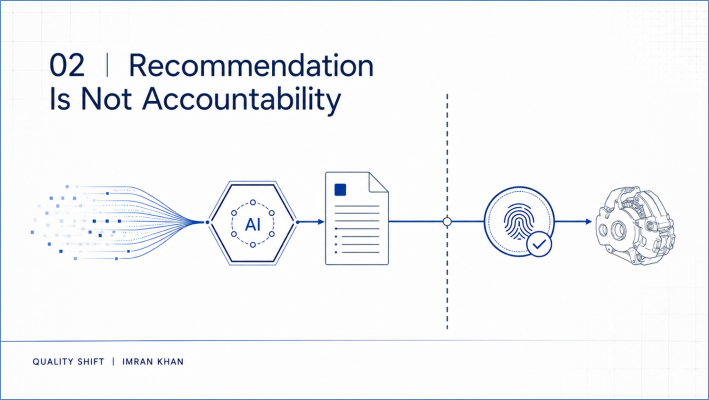
The recommendation passes through an approval checkpoint, the component is released, and production continues. Everything appears controlled until a customer discovers that a defective component was classified as acceptable.
The immediate explanation may be:
“The AI system approved it.”
But an AI system cannot accept accountability. It cannot explain the decision to the customer, lead a corrective action, approve a deviation or answer an auditor.
The model may have generated the recommendation, but the organisation released the product. That distinction is becoming increasingly important as artificial intelligence enters inspection, process control, supplier management, complaint analysis and other quality-related activities.
The question is no longer whether quality functions will use AI. The more important question is:
When AI influences a quality decision, who remains accountable for its consequences?
1. AI Is Already Entering Quality Decisions
AI in quality is not limited to futuristic autonomous factories. It is already influencing decisions in several practical areas.
Computer-vision systems classify surface defects, dimensional abnormalities and assembly errors.
Predictive models analyse process parameters and identify the likelihood of equipment failure or process deviation.
AI tools examine customer complaints, group similar failures and recommend investigation priorities.
Supplier-risk systems combine delivery, quality, capacity and financial information to identify suppliers requiring attention.
Generative AI can help quality engineers summarise audit evidence, interpret trends, prepare preliminary root-cause hypotheses and draft corrective-action reports.
In each case, AI converts data into a recommendation that may influence a quality decision.
However, the level of influence is not always clearly defined.
Is the AI output only an additional input for a qualified person?
Does the user normally accept the recommendation unless something appears unusual?
Or does the system automatically approve, reject, prioritise or release without individual review?
These are fundamentally different operating models, but organisations may treat them as if they were the same.
Before deploying AI, the organisation must therefore define whether the system:
- Provides information
- Generates a recommendation
- Supports a human decision
- Makes a decision subject to later review
- Executes a decision automatically
The greater the influence of AI on the final outcome, the stronger the required validation, monitoring, escalation and governance should be.
2. Recommendation Is Not Accountability
An AI model can recommend that a component is acceptable.
It can calculate the probability of a defect.
It can rank suppliers according to perceived risk.
It can identify an apparent root cause from historical data.
But recommendation authority and accountability are not the same.
Accountability belongs to the role or function authorised by the organisation to own the decision and its consequences.
If an AI-supported inspection system releases a defective product, responsibility does not disappear into the algorithm. The organisation must still be able to identify:
- Who approved the intended use of the AI system
- Who established the acceptance criteria
- Who validated its performance
- Who authorised its use in production
- Who monitors incorrect classifications
- Who can override or stop the system
- Who owns the resulting product decision
This does not mean that a person must manually approve every output from every AI system.
Human accountability is not necessarily the same as continuous manual intervention.
An automated inspection system may process thousands of components without individual approval. Nevertheless, an identified process owner must remain accountable for the system’s suitability, controls, monitored performance and escalation criteria.
Automation may change how a decision is executed.
It does not eliminate organisational accountability for that decision.
3. Why “The System Decided” Is Not a Root Cause
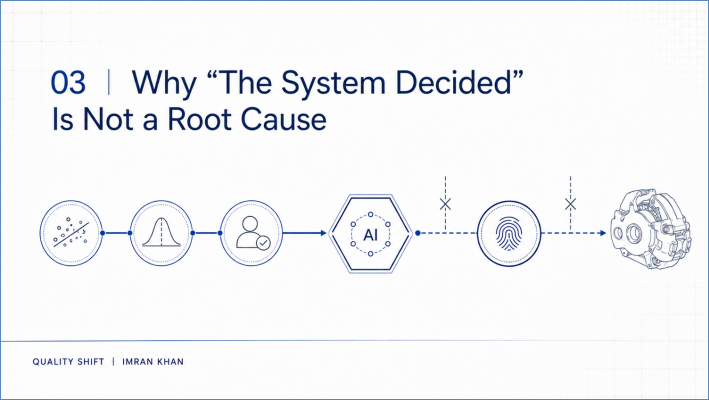
Suppose an AI vision system fails to detect a crack and classifies the component as acceptable.
“The AI system approved the component” describes what happened.
It does not explain why it happened.
A meaningful investigation may need to examine whether:
- The training data contained sufficient examples of that defect
- The images represented actual production conditions
- Lighting, position or surface variation affected detection
- The acceptance threshold was appropriate
- The model had been validated for that product variant
- A software or model update changed performance
- Operators understood when manual verification was required
- False accepts were being monitored
- The system continued operating outside its validated conditions
The failure mechanism may exist in the data, model, equipment, operating environment, decision threshold, validation method or governance process.
Treating “AI error” as the root cause is similar to treating “operator error” as the final root cause. Both can stop the investigation before the system conditions behind the failure are understood.
AI introduces another important complication: model performance may change even when the software itself has not visibly failed.
Changes in materials, suppliers, product variants, camera conditions, defect patterns or process behaviour can make current operating data different from the data used during model development.
A model that performed adequately during initial validation may therefore become less effective over time.
Root-cause analysis must look beyond the AI output and investigate the entire decision system.
4. What an AI-Enabled QMS Must Define
A quality management system cannot control AI merely by listing it as another inspection tool.
Its use must be integrated into existing controls for competence, validation, change management, monitoring, nonconformity, documented information and management responsibility.
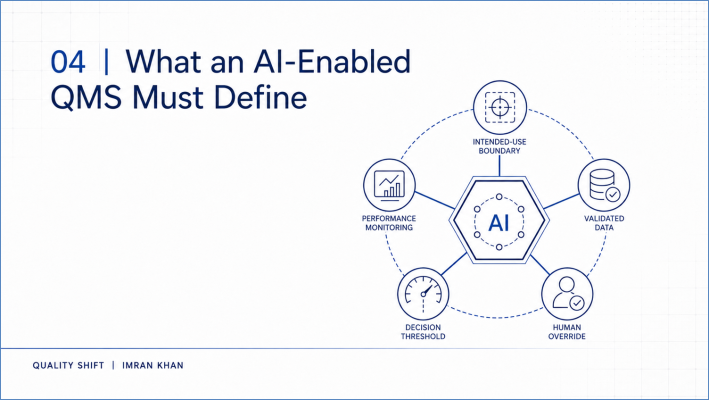
At minimum, an AI-enabled QMS should define five elements.
Intended-use boundary
The organisation must specify what the AI system is authorised to do—and what it is not authorised to do.
A model validated for one component, defect type, production line or operating condition should not quietly be extended to another application without review.
Validated data
The organisation should understand the origin, quality, relevance and limitations of the data used to develop and validate the model.
A large volume of data is not automatically representative data.
Rare but critical defects may be poorly represented even in a very large dataset.
Decision threshold
The system’s sensitivity and acceptance threshold must reflect the consequences of incorrect decisions.
A false reject creates unnecessary scrap or reinspection.
A false accept can allow a defective or potentially unsafe product to reach the customer.
These risks are not equivalent, and the decision threshold should not be selected only to maximise overall model accuracy.
Human override and escalation
Users must know when they may override the system, when additional verification is required and when production or release must be stopped.
Overrides should also be recorded and analysed. Frequent human overrides may indicate that the model or its operating boundaries are no longer suitable.
Performance monitoring
Initial validation is insufficient.
The organisation should continue monitoring false accepts, false rejects, overrides, escapes, changes in operating conditions and performance across different products or defect categories.
AI performance should be treated as a controlled process characteristic—not as a one-time software qualification.
5. A Practical Accountability Model
Accountability for an AI-supported quality decision should not be assigned vaguely to “the AI team” or “the quality department.”
Different roles own different parts of the decision system.
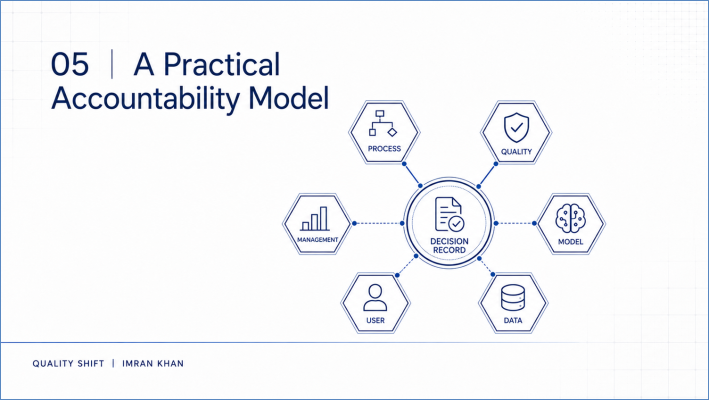
RolePrincipal accountabilityProcess ownerDefines the application, operating conditions and intended-use boundariesQuality functionEstablishes acceptance criteria, product-risk controls and verification requirementsModel ownerControls model validation, configuration, updates and technical performanceData ownerEnsures the suitability, integrity, traceability and representativeness of dataUserApplies the defined review, override and escalation rulesManagementApproves governance, resources, responsibilities and acceptable residual risk
These responsibilities should converge in a traceable decision record.
For significant applications, the organisation should be able to determine:
- Which model and version produced the output
- What input data was used
- What operating conditions existed
- What recommendation was generated
- Whether a human reviewed or overrode it
- Which acceptance criteria were applied
- Who was authorised to own the final decision
Without this traceability, investigations may become dependent on assumptions after the event.
The strongest accountability model is not one in which everyone is involved.
It is one in which every critical responsibility has one clearly identified owner.
6. Questions Leaders and Auditors Must Begin Asking
AI governance should not remain solely with information technology or data-science teams.
Quality leaders, process owners and auditors need to understand how AI influences controlled decisions within the management system.
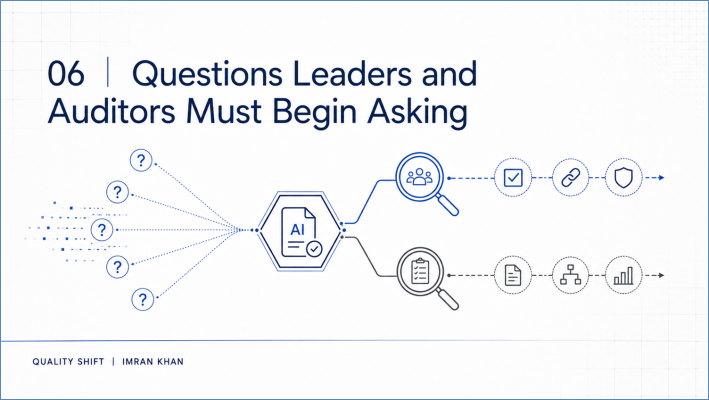
They should begin asking:
- What quality decisions are currently influenced by AI?
- Is the AI providing information, recommending a decision or executing it?
- Who owns the final outcome?
- What was the system validated to detect or predict?
- Under what conditions is that validation considered valid?
- How are false accepts and false rejects monitored?
- What happens when the model encounters an unfamiliar condition?
- Who can override or stop the system?
- How are model, software and threshold changes controlled?
- Can the organisation reconstruct a significant historical decision?
- How are users trained to recognise the system’s limitations?
- When is revalidation required?
- How is AI-related performance reviewed by management?
These questions are not intended to resist AI adoption.
They are necessary to ensure that greater automation does not create weaker accountability.
AI can identify patterns that people may overlook. It can improve inspection speed, analyse more data and support earlier intervention. Used responsibly, it can significantly strengthen quality decision-making.
But confidence in AI should not become a substitute for control over AI.
The algorithm may recommend the decision.
The system may execute it.
But the organisation must still know who is accountable for the outcome.
The greatest risk may not be that AI makes an incorrect recommendation.
It may be that everyone relies on the recommendation while nobody clearly owns the decision.