In many ISO 26262 programs, teams confidently say:
“We have validated AEBS.”
But when the evidence is reviewed, what is often presented is extensive testing — not necessarily validation in the functional safety sense. Verification and validation are not synonyms. They answer different engineering questions and require different evidence. Confusing them does not just create terminology issues — it weakens the safety case that connects hazard analysis to safe vehicle behavior. Let us clarify this using AEBS as a reference item.
1. Definitions in ISO 26262 Context
1.1 Verification
Verification is the confirmation that specified requirements are fulfilled. It answers the question:
Are we building the system right?
Verification ensures that:
- Safety requirements are correctly derived
- Requirements are correctly allocated
- Design elements implement those requirements
- The implementation behaves as specified
Verification is requirement-driven and occurs at system, hardware, software, and integration levels. It provides evidence of design conformance.
1.2 Validation
Validation is the confirmation that the Safety Goals are achieved in the intended operational context. It answers the question:
Are we building the right system to mitigate the identified hazard?
Validation ensures that:
- Hazards identified in HARA are effectively mitigated
- Safety Goals are achieved at item level
- The vehicle remains safe in real operating conditions
Validation is hazard-driven and primarily occurs at item (vehicle) level. It provides evidence of safety effectiveness.
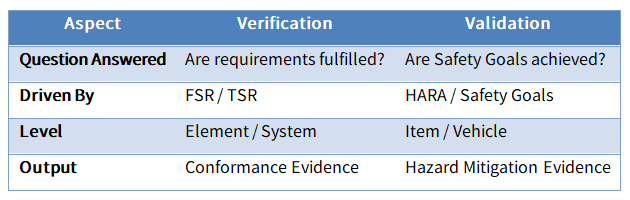
1.3 Definition Contrast
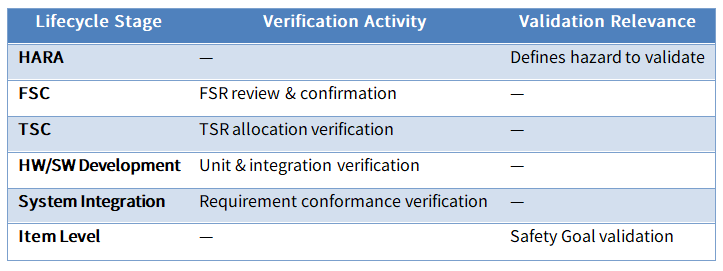
2. Where They Sit in the ISO 26262 Lifecycle
A simplified Functional Safety flow looks like this:
- Item Definition
- HARA
- Safety Goals
- Functional Safety Concept
- Technical Safety Concept
- System, HW, SW Development
- Integration and Testing
- Safety Validation
Verification activities are embedded throughout stages 4 to 7. Validation occurs at stage 8 and confirms that the Safety Goals derived from HARA are achieved at vehicle level. Verification travels along the development chain. Validation closes the loop back to the hazard.
3. AEBS Reference Case
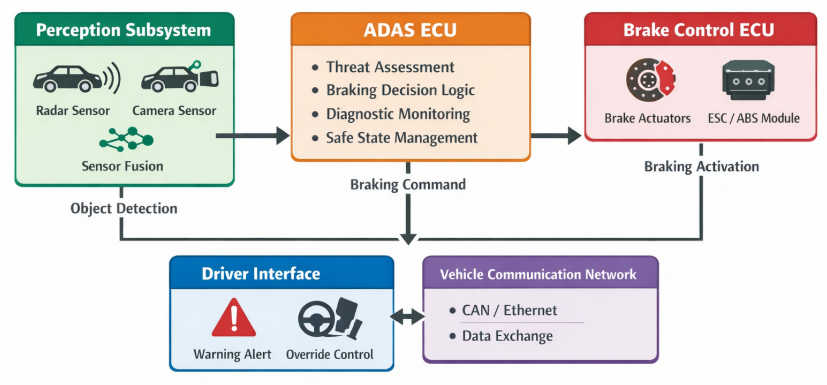
Hazard : Unintended full braking at highway speed.
Safety Goal : Prevent unintended autonomous braking.
From this Safety Goal, Functional Safety Requirements and Technical Safety Requirements are derived and allocated to system elements. Now the difference between verification and validation becomes visible.
4. What Verification Looks Like in AEBS
Verification confirms that derived requirements are correctly implemented. Typical verification activities include:
- Confirming FSR are correctly derived from the Safety Goal
- Confirming TSR are properly allocated
- Reviewing software braking trigger logic
- Verifying diagnostic monitoring of sensors
- Confirming safe state behavior upon fault detection
- Checking FTTI compliance
- Verifying ASIL decomposition correctness
Typical evidence includes:
- Requirement traceability matrices
- Design reviews
- Static analysis
- Unit testing
- Integration testing
- Fault injection testing
- SPFM and PMHF evaluation
Verification demonstrates that the safety design is implemented as specified. It does not yet demonstrate that the vehicle is safe in real operation.
5. What Validation Looks Like in AEBS
Validation confirms that the Safety Goal is achieved at item level. For the AEBS example, validation demonstrates that:
- Unintended braking does not occur in real driving conditions
- Under injected faults, the system transitions to a safe state
- Driver override functions correctly
- The hazard identified in HARA is effectively mitigated
Typical evidence includes:
- Vehicle-level validation testing
- Integrated fault campaigns
- Proving-ground trials
- System-level safety confirmation
Validation closes the loop between:
Hazard → Safety Goal → Safe vehicle behavior.
6. Direct Comparison
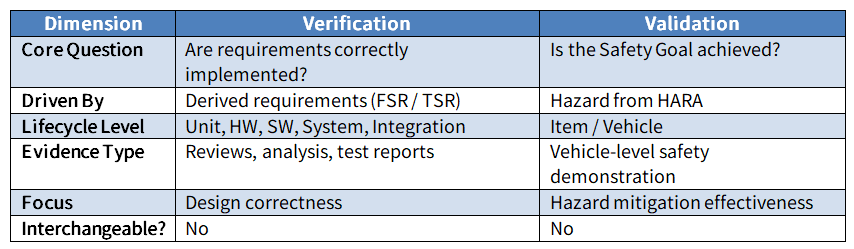
7. Common Myths
Myth 1: Validation happens only at the end. Reality: Validation strategy must be planned from the Safety Concept stage.
Myth 2: If everything is verified, validation is automatic. Reality: A perfectly implemented design can still fail to mitigate the real-world hazard.
Myth 3: System testing equals validation. Reality: If testing only confirms requirement conformance, it remains verification.
8. The Engineering Takeaway
- Verification ensures the AEBS design is correctly built.
- Validation ensures the vehicle will not brake unintentionally in real life.
- Verification provides design conformance evidence. Validation provides hazard mitigation evidence.
- Both are mandatory in ISO 26262. Neither replaces the other.
- The distinction is not semantic. It is structural and critical to a defensible safety case.