Should Traceability Be Fixed or Dynamic?
"How far should traceability really go?"
-------------------------------------------------
Many organisations either do too little traceability or try to trace everything.
Both approaches create problems.
Too little traceability means weak containment, weak root cause analysis and higher risk during recalls.
Too much traceability creates unnecessary complexity, cost and paperwork.
-------------------------------------------------
In my view, traceability should not be fixed for every part and every situation.
It should be risk based and dynamic.
Some parts naturally need stronger traceability because the business impact of failure is much higher.
Examples include:
• Safety related parts
• Regulatory or homologation related parts
• Special Characteristics
• Parts with high DFMEA or PFMEA severity
• Parts with high warranty or recall risk
• Parts with major complaint history
• Parts with software, calibration or parameter settings
• Parts with multiple cavities, tools or process routes
• Parts with high supplier batch variation risk
For such parts, batch level traceability alone may not be enough.
-------------------------------------------------
The organisation may need traceability for:
• Supplier lot / heat number
• Machine number
• Tool or cavity number
• Shift and operator
• Process parameter settings
• Inspection records
• Rework history
• Software or calibration version
• Dispatch lot and shipment details
At the same time, not every low-risk standard fastener or simple bracket needs the same traceability depth as a braking component, steering part or battery-related component.
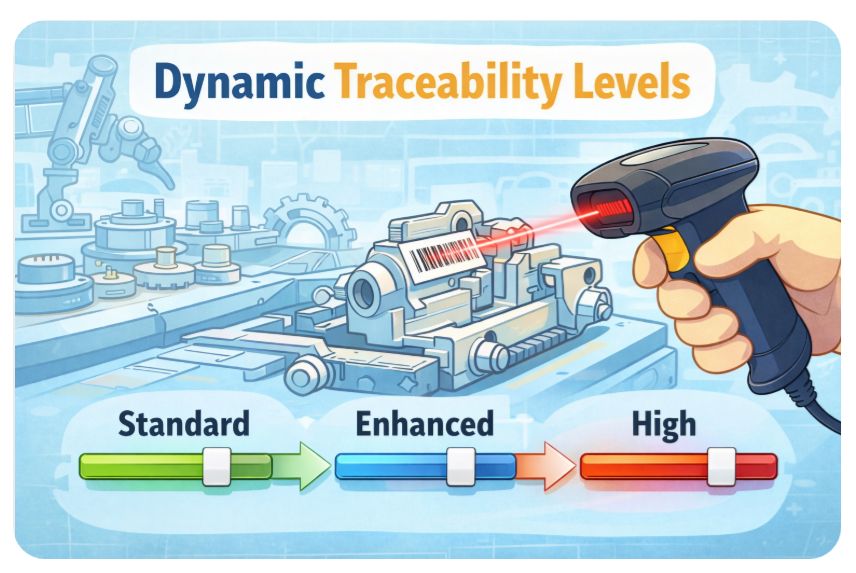
That is where dynamic traceability becomes important.
Dynamic traceability means the level of traceability changes depending on the risk at that point in time.
For example:
• Stable production may only need normal lot traceability
• New launches may require shift-wise or hourly traceability
• Supplier issues may require temporary cavity, machine or operator traceability
• Recurring complaints may require tighter traceability until confidence is restored
• Engineering changes or software updates may require serial-level traceability for a limited period
This helps organisations strengthen traceability where risk is high without creating permanent complexity for every part.
# Question for Group
• Do you believe traceability should always remain fixed?
• Or should organisations move towards a more dynamic traceability model based on risk, complaints, launches, supplier issues and engineering changes?
Interested to hear how OEMs, suppliers and auditors look at this.
#IATF16949 #Traceability #RiskManagement #SpecialCharacteristics #PFMEA #AutomotiveQuality