What is more dangerous?
A system that fails?
Or a system that works exactly as designed—but is still unable to handle the situation safely?
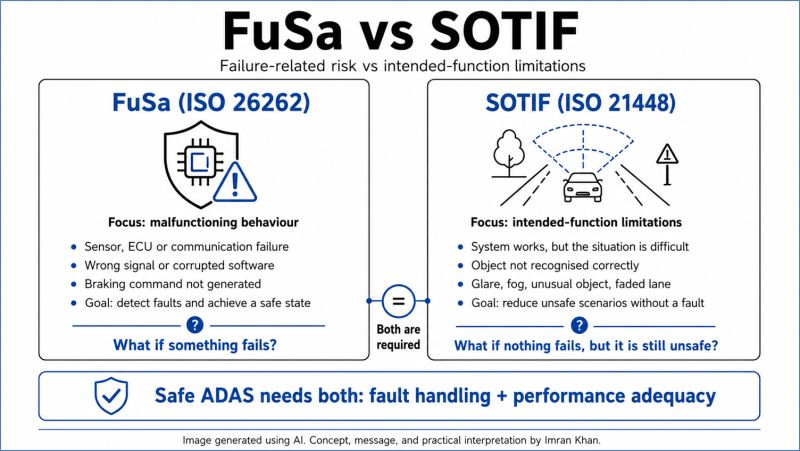
This is the practical difference between Functional Safety (FuSa) and SOTIF.
Functional Safety asks:
“What happens when something malfunctions?”
For example:
• A camera stops communicating
• A sensor provides an incorrect value
• Software execution is corrupted
• A braking command is not generated
• An electronic control unit becomes unavailable
The focus is on:
• Identifying faults
• Preventing or controlling failures
• Detecting abnormal behaviour
• Transitioning to or maintaining a safe state
Now consider a different situation.
The camera is working.
The algorithm is running.
The braking system is available.
But the vehicle still fails to recognise:
• A partially obstructed pedestrian
• A faded lane marking
• An unusual road object
• Heavy rain, glare or fog
• A scenario not adequately represented during development
Nothing has technically failed.
Yet the vehicle may still behave unsafely.
This is where SOTIF becomes important.
SOTIF asks:
“What happens when nothing fails, but the intended functionality is not capable enough for the situation?”
The focus is on:
• Functional limitations
• Sensor and algorithm insufficiencies
• Foreseeable misuse
• Challenging operating scenarios
• Unknown or inadequately understood conditions
So, the distinction can be remembered simply:
FuSa
Unsafe behaviour caused by a malfunction
SOTIF
Unsafe behaviour caused by a functional insufficiency, even without a malfunction
These are not competing approaches.
For ADAS and automated-driving functions, both are essential.
A system is not safe merely because it is fault-free.
It must also be capable of handling the situations in which it is expected to operate.
FuSa asks:
“What if something fails?”
SOTIF asks:
“What if nothing fails, but the system is still not good enough?”
Which one is more difficult to demonstrate in your current projects: FuSa or SOTIF?
#FunctionalSafety #SOTIF #ISO26262 #ISO21448 #ADAS #AutomotiveSafety #AutomotiveEngineering