The FMEA score improved.
The process still made the same defect.
How is that possible?
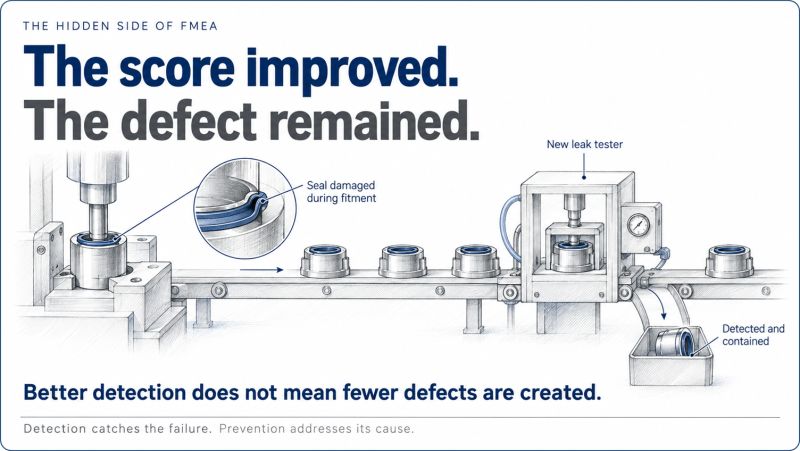
Imagine an assembly line where a seal gets damaged during fitment.
The team installs an automatic leak tester.
Failed parts are blocked from dispatch.
The detection rating improves.
Everyone feels more confident.
Then someone asks a simple question.
“Are we damaging fewer seals?”
“No. But now we catch them.”
That is an easily missed distinction in FMEA.
Better detection can reduce the chance of a defect reaching the customer.
It does not, by itself, reduce the chance of creating that defect.
The leak tester detects the problem.
A change to the fitting method, tooling or design may prevent it.
Both are valuable.
But they achieve different things.
In a PFMEA, adding inspection alone does not justify reducing Occurrence. And better detection does not make the potential failure effect less severe.
Before closing an action, ask three questions.
- Have we reduced the consequence?
- Have we reduced the likelihood of the cause?
- Or have we improved our ability to detect the failure?
The answer should decide which rating changes.
A better FMEA should make the engineering improvement visible, not just the numerical improvement.
In your last FMEA review, did the action prevent the defect or improve its detection?
#FMEA #QualityEngineering #RiskManagement